
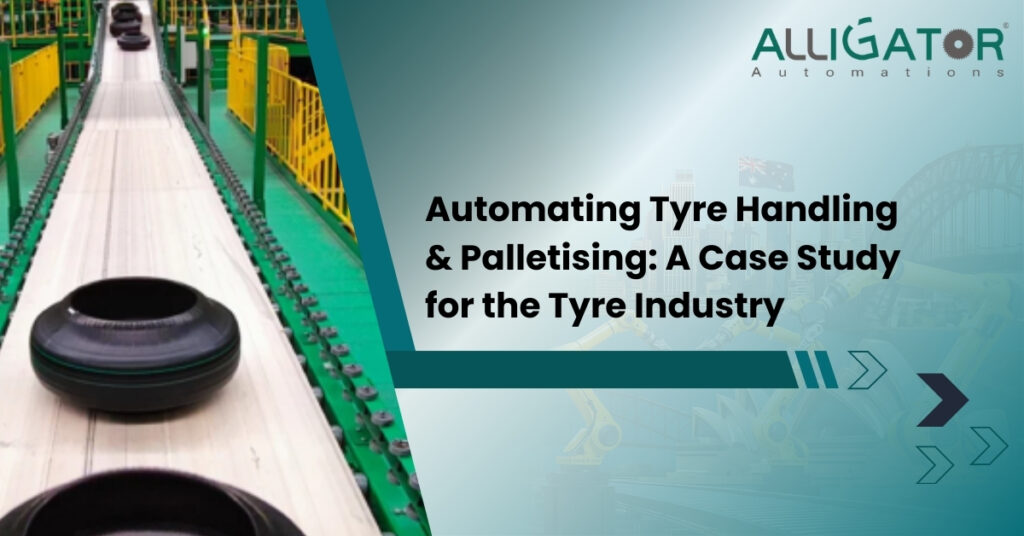
Automating Tyre Handling & Palletising: A Case Study for the Tyre Industry
Summary: Automation is rapidly transforming the tyre manufacturing industry by improving efficiency, safety, and productivity. Manual tyre handling often leads to worker fatigue, inconsistent pallet stacking, and operational bottlenecks. By integrating automated tyre handling systems, conveyor technologies, robotic palletising, and stretch wrapping solutions, manufacturers can streamline operations and reduce reliance on manual labour. This case study explores how automation can optimize tyre handling processes, improve workplace safety, and enhance logistics efficiency in modern tyre production facilities.
Table of Contents
ToggleThe tyre manufacturing industry operates in a highly competitive and demanding environment where efficiency, safety, and productivity are critical. Tyre manufacturers handle thousands of tyres daily, moving them through multiple stages such as inspection, sorting, stacking, palletising, and loading for distribution. Traditionally, many of these tasks have been performed manually, which often leads to inefficiencies, workplace injuries, and inconsistent output.
With the rise of advanced automation technologies, tyre manufacturers are increasingly adopting automated tyre handling and palletising systems. These solutions streamline production processes, reduce manual labour, improve worker safety, and ensure consistent pallet stacking for efficient logistics.
This blog presents a case study-style overview of how automating tyre handling and palletising can transform operations in the tyre industry.
Challenges in Manual Tyre Handling
Before implementing automation, many tyre manufacturing facilities rely on manual labour to handle finished tyres. While this approach may seem straightforward, it presents several operational challenges.
Heavy and Repetitive Lifting
Tyres, particularly those used in trucks, buses, and industrial vehicles, can be heavy and bulky. Workers repeatedly lift, move, and stack tyres throughout the day. Over time, this repetitive work can lead to fatigue, musculoskeletal injuries, and decreased productivity.
Inconsistent Pallet Stacking
Manual stacking often results in uneven or unstable pallet loads. Inconsistent stacking patterns can cause issues during storage and transportation, increasing the risk of pallet collapse or product damage.
Slow Throughput
Manual processes limit the speed at which tyres can be sorted, stacked, and palletised. As production volumes increase, bottlenecks often occur in the packaging and logistics stages.
Workplace Safety Risks
Handling tyres manually involves bending, lifting, and twisting movements, which significantly increase the risk of workplace injuries. Additionally, busy production lines create environments where accidents can occur if proper handling procedures are not followed.
These challenges highlight the need for automated solutions that improve both operational efficiency and worker safety.
The Role of Automation in Tyre Handling
Automated tyre handling systems are designed to manage tyres from the end of the production line through sorting, stacking, palletising, and preparation for shipment.
These systems typically include conveyors, robotic arms, automated grippers, palletising machines, and stretch wrapping equipment. By integrating these technologies into the production workflow, manufacturers can significantly improve operational performance.
Automation ensures consistent handling, reduces manual labour requirements, and enables tyre manufacturers to scale their operations more effectively.
Case Study: Implementing Automated Tyre Handling & Palletising
A large tyre manufacturing facility producing passenger and commercial vehicle tyres faced several operational challenges. The company needed to improve throughput, reduce worker fatigue, and optimize pallet loading for distribution.
Initial Situation
The factory relied heavily on manual labour to move tyres from the production line to the palletising area. Workers manually lifted tyres from conveyors, stacked them onto pallets, and prepared them for shipping.
The key problems included:
Frequent worker fatigue and injuries
Inconsistent pallet stacking patterns
Production bottlenecks during peak output periods
Limited ability to scale operations as demand increased
To address these issues, the manufacturer decided to implement a fully automated tyre handling and palletising system.
The Automation Solution
The automation solution included several integrated components designed to streamline tyre movement and pallet preparation.
Automated Conveyor Systems
Conveyor systems were installed to transport tyres directly from the production line to sorting and palletising stations. These conveyors reduced the need for manual transport and ensured a continuous flow of tyres.
Advanced sensors were also integrated to track tyre movement and prevent jams or misalignment. Many tyre manufacturers work with specialised providers such as a Tire Handling Conveyors Manufacturer in Australia to design customised conveyor systems that match their production requirements.
Tyre Orientation and Sorting
Before palletising, tyres must be properly oriented. Automated systems were used to align tyres in the correct position to ensure consistent stacking.
Sorting mechanisms were also implemented to separate tyres based on size, type, or order requirements.
Robotic Tyre Handling
Industrial robotic arms equipped with specialised tyre grippers were introduced to handle the tyres. These robots can lift tyres of various sizes and stack them precisely according to pre-programmed patterns.
The robotic system ensures accurate placement, improving pallet stability and reducing the risk of product damage.
Automated Palletising
Automated palletisers were integrated to stack tyres onto pallets in optimised configurations. These machines are capable of handling high volumes while maintaining consistent stacking patterns.
Operators can easily adjust pallet configurations based on tyre size or shipping requirements.
Stretch Wrapping for Load Stability
After palletising, automated stretch wrapping machines secure the pallet load with protective film. This ensures that tyres remain stable during transport and storage.
Results Achieved
After implementing automated tyre handling and palletising systems, the manufacturer experienced significant improvements across several areas.
Increased Productivity
Automation enabled the facility to process tyres much faster than manual handling allowed. The production line maintained a continuous flow without bottlenecks in the palletising stage.
Improved Worker Safety
By eliminating heavy lifting tasks, the company significantly reduced workplace injuries and worker fatigue. Employees were reassigned to more skilled supervisory and maintenance roles.
Consistent Pallet Quality
Automated palletising ensured uniform stacking patterns for every pallet. This improved pallet stability and reduced the risk of damage during transportation.
Reduced Operational Costs
Although the initial investment in automation was substantial, the long-term savings in labour costs, injury-related expenses, and improved efficiency resulted in a strong return on investment.
Better Space Utilisation
Optimised pallet stacking allowed the manufacturer to store and transport more tyres per pallet, improving warehouse space usage and reducing logistics costs.
Key Technologies Driving Tyre Automation
Several technologies are responsible for making automated tyre handling possible.
Robotics
Robotic arms equipped with specialised gripping systems can safely handle tyres of different sizes and weights. These robots provide precision and flexibility in pallet stacking.
Smart Sensors
Sensors monitor tyre movement throughout the system, detecting jams, misalignment, or irregularities. This helps maintain smooth operations.
Conveyor Integration
Automated conveyors ensure seamless tyre movement between production stages without requiring manual intervention.
Software Control Systems
Centralised control software allows operators to monitor the entire process in real time. The system can also adjust pallet patterns or processing speeds based on production needs.
The Future of Automated Tyre Handling
Automating tyre handling and palletising represents a major opportunity for tyre manufacturers to improve efficiency, safety, and scalability. Manual handling processes often create bottlenecks, increase injury risks, and limit production capacity.
By implementing automated conveyors, robotic handling systems, and intelligent palletising equipment, tyre manufacturers can significantly streamline their operations.
As the tyre industry continues to grow and demand increases, automation will become an essential component of modern manufacturing facilities. Companies that adopt these technologies early will gain a competitive advantage through improved productivity, reduced costs, and enhanced operational reliability.
Automated tyre handling is no longer just an innovation—it is rapidly becoming the standard for efficient tyre manufacturing and logistics.
FAQs
Why is automation important for tyre palletising?
Automation improves the accuracy and consistency of pallet stacking. Automated palletising systems create stable and uniform pallet loads, reducing the risk of product damage during storage and transportation while increasing overall production speed.
What types of tyres can automated handling systems manage?
Modern automated tyre handling systems are designed to handle a wide range of tyres, including passenger vehicle tyres, truck tyres, agricultural tyres, and industrial tyres. Adjustable gripping systems and conveyor configurations allow the equipment to accommodate different sizes and weights.
How does automation improve worker safety in tyre manufacturing?
Automation eliminates the need for workers to repeatedly lift and stack heavy tyres. By reducing manual handling tasks, manufacturers can lower the risk of workplace injuries, fatigue, and musculoskeletal strain.
Can automated tyre handling systems be customised for different factories?
Yes, most automation solutions are designed to be customised based on factory layout, tyre size range, and production capacity. Manufacturers often work with specialised system integrators or a Tire Handling Conveyors Manufacturer in Australia to develop solutions tailored to their specific operational requirements.
Recent Posts
Categories
Browse Our Automation Solutions
Explore our complete product catalogue and find the perfect solution for your industry.