
Summary: This blog explains how to choose the right palletizing system for your business by exploring different automation types, key selection factors, and operational benefits. It helps you understand how end-of-line packaging systems improve efficiency, reduce costs, and support scalable production. Whether you are upgrading existing operations or planning new automation, this guide will help you make a more informed and profitable decision.
Choosing the right palletizing system is an important step for improving packaging efficiency and overall production performance in modern industries. With growing demand for faster, safer, and more reliable operations, businesses are shifting toward automated end-of-line packaging solutions. The right system not only streamlines product handling but also reduces labor dependency and operational errors. In this blog, we will explore how to select the ideal palletizing system based on your business needs and how it can support long-term growth and productivity.
What Is A Palletizing System And How Does It Work?
A palletizing system is an automated or semi-automated solution used to stack products, boxes, or packages onto pallets in a structured and efficient manner. It is a crucial part of end-of-line packaging systems and plays a major role in logistics, warehousing, and distribution.
In simple terms, palletizing replaces manual stacking with automated precision. Products coming from production lines are arranged, grouped, and stacked systematically for safe transportation and storage.
How It Works In Industrial Environments?
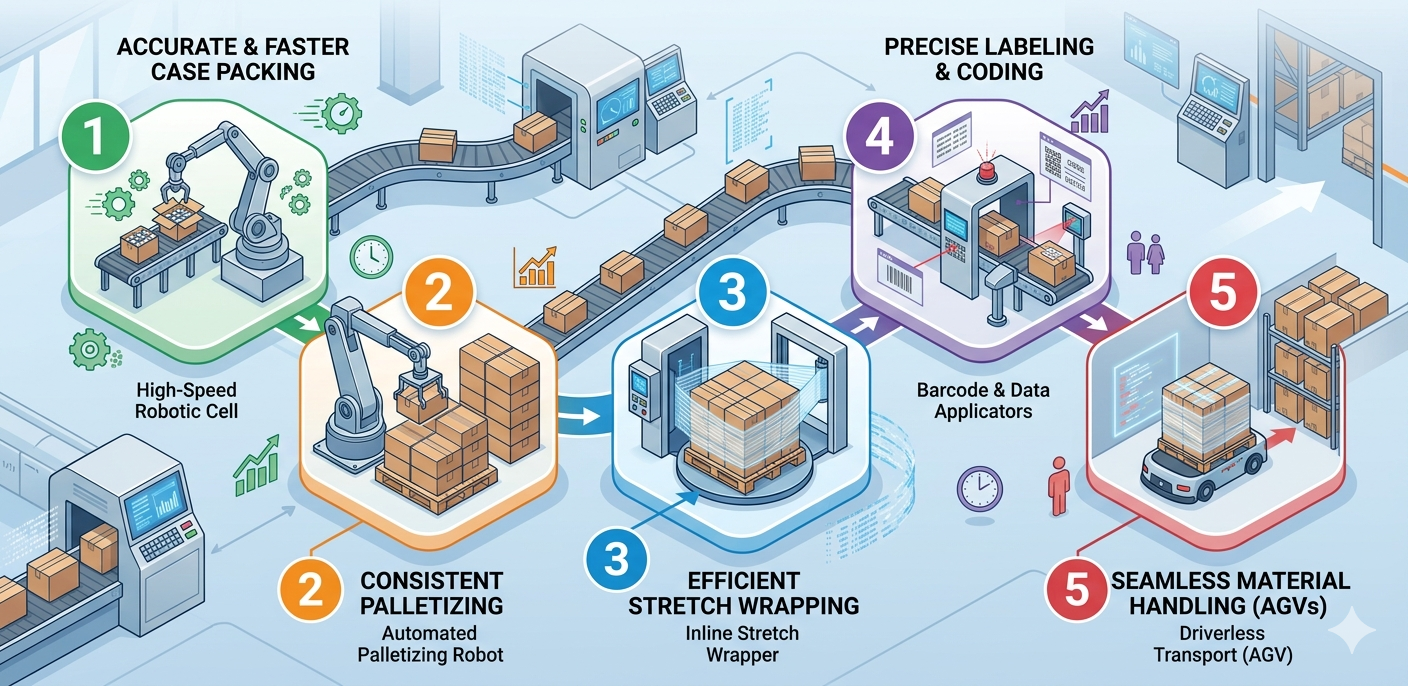
Most palletizing systems follow a structured workflow:
- Products arrive via conveyor systems
- They are grouped based on predefined patterns
- A robotic arm or mechanical layer system stacks them on pallets
- Completed pallets are wrapped and moved for shipping
This automation significantly reduces human effort and ensures consistency in stacking quality.
Why Choosing The Right Palletizing System Matters For Your Business?
Selecting the right palletizing system directly impacts productivity, operational cost, and supply chain efficiency. A poorly matched system can lead to bottlenecks, product damage, and increased downtime.
Key Business Benefits Include
- Improved packaging speed and throughput
- Reduced dependency on manual labor
- Enhanced workplace safety
- Consistent pallet stability and load accuracy
- Lower long-term operational costs
For manufacturing and distribution businesses, the right system is not just equipment—it is a long-term investment in efficiency and scalability.
Which Types Of Palletizing Systems Are Available In The Market?
Understanding the available palletizing technologies is essential for selecting the right automation solution for your production line. Different systems are designed to meet varying speed requirements, product types, and facility layouts. Choosing the correct system ensures better efficiency, flexibility, and long-term operational performance.
Robotic Palletizer
Robotic palletizers use advanced robotic arms with programmable movements to stack products with precision. They are highly flexible and suitable for businesses handling multiple SKUs, frequent changeovers, or complex stacking patterns.
Gantry Palletizer
Gantry palletizers operate using a linear overhead structure that moves along X, Y, and Z axes to pick and place products. They are ideal for heavy-duty applications and high-speed operations requiring consistent accuracy and strength.
High Level Palletizer
High-level palletizers receive products from an elevated conveyor system and stack them downward onto pallets. They are widely used in fast-paced production environments where gravity-assisted product flow improves efficiency.
Low Level Palletizer
Low-level palletizers pick products from ground-level conveyors and build pallets upward layer by layer. They are easier to maintain and are suitable for operations with moderate production speeds and limited overhead space.
Hybrid Palletizer
Hybrid palletizers combine the advantages of robotic and conventional systems, offering both flexibility and high throughput. They are ideal for businesses that require adaptability for multiple product types while still maintaining strong production efficiency.
How To Choose The Right Palletizing System For Your Business?
Selecting the right system requires careful evaluation of multiple operational factors. A one-size-fits-all approach does not work in industrial automation.
Analyze Your Production Volume
High-speed production lines require robust, high-throughput palletizing systems, while smaller operations may benefit from flexible robotic solutions.
Evaluate Product Type And Packaging
Consider whether your products are fragile, heavy, irregularly shaped, or uniform. This determines the type of gripping system and stacking method required.
Assess Floor Space Availability
Space constraints can influence whether you choose a compact robotic system or a larger conventional setup.
Consider Flexibility Requirements
If your business handles multiple product lines, a robotic palletizer offers better adaptability than fixed mechanical systems.
Determine Integration Needs
Your palletizing system should integrate seamlessly with conveyors, packaging machines, and warehouse systems.
What Factors Should You Consider Before Investing In A Palletizing System?
Investing in end-of-line packaging automation requires strategic planning. Beyond initial cost, several operational factors should be evaluated.
Total Cost Of Ownership
Instead of focusing only on purchase price, consider maintenance, energy consumption, and long-term operational savings. A lower upfront cost may lead to higher long-term expenses, so evaluating overall lifecycle cost is essential.
Maintenance And Downtime
Choose systems with easy maintenance access and reliable support to minimize production disruptions. Quick servicing and readily available spare parts help ensure uninterrupted workflow and higher productivity.
Scalability For Future Growth
Your system should be able to handle increased production demands as your business expands. A scalable solution allows you to upgrade capacity without replacing the entire system later.
Safety And Compliance Standards
Modern palletizing systems should comply with industrial safety regulations to protect workers and equipment. Proper compliance also reduces workplace risks and ensures smooth audit and certification processes.
Return On Investment Timeline
Evaluate how quickly the system will pay for itself through labor savings and efficiency improvements. A clear ROI timeline helps you make a confident and financially sound automation investment decision.
How Can Automation Improve End Of Line Packaging Efficiency?
Automation plays a transformative role in modern packaging operations. By integrating advanced palletizing systems, businesses can significantly improve workflow efficiency.
- Automated systems operate continuously without fatigue, ensuring consistent output and helping businesses meet higher production demands efficiently.
- Automation minimizes stacking errors and product damage, improving overall packaging quality while ensuring more reliable and consistent operations.
- Employees can be reassigned from repetitive tasks to higher-value roles, improving overall productivity and workforce efficiency across the facility.
- Uniform pallet stacking improves storage efficiency and transportation safety, making warehouse management smoother and more organized for large-scale operations.
- Modern systems provide data tracking and performance monitoring for better decision-making, helping businesses optimize performance and reduce downtime effectively.
Get Expert Palletizing Solutions For Better Operational Performance
If you are looking to improve efficiency, reduce manual labor costs, and upgrade your end-of-line packaging operations, now is the right time to invest in a reliable palletizing solution. At Alligator Automations Australia, we specialize in delivering advanced, customized palletizing systems designed to match your production needs and industry requirements. Whether you operate a high-speed manufacturing line or a flexible packaging unit, our automation experts ensure seamless integration, higher productivity, and long-term operational savings. We provide automated palletizing systems & solutions designed to improve speed, accuracy, and efficiency in end-of-line packaging operations.
Take the next step toward smarter automation and future-ready packaging solutions. To explore the right palletizing system for your business or to get expert guidance tailored to your facility, Contact us today. Our team is ready to help you design, implement, and optimize the perfect end-of-line packaging system that enhances efficiency, safety, and overall performance.