Summary: Australia and New Zealand (ANZ) are rapidly transforming into a hub for smart manufacturing, where automation, data, and intelligent systems are reshaping traditional production. Businesses are no longer relying only on manual processes; they’re integrating connected technologies that improve efficiency, consistency, and scalability. This shift is helping manufacturers stay competitive while meeting growing global demand with smarter, faster operations.
Manufacturing today is no longer just about producing goods; it’s about producing them smarter, faster, and with precision. Across Australia and New Zealand, industries are moving beyond traditional methods and adopting connected, automated, and data-driven systems that transform how production lines operate.
This shift, known as smart manufacturing, is redefining factories from the ground up. Machines now communicate, analyze data in real time, and optimize performance, whether it’s packaging lines adapting to demand or systems predicting maintenance before failures occur.
In this article, we’ll explore what’s driving this transformation in the ANZ region, how industries are evolving, and why end-of-line automation is becoming a key factor in building efficient, future-ready operations.
Why ANZ Is Emerging as a Smart Manufacturing Hub?
1. Government Support Driving Innovation
Governments across ANZ are actively encouraging manufacturers to adopt advanced technologies through funding, policies, and innovation programs. This support reduces the risk associated with upgrading traditional systems.
- Grants and funding for automation and digital transformation
- Incentives for adopting advanced manufacturing technologies
- Support for research and industry collaborations
- Policies promoting Industry 4.0 adoption
With these initiatives in place, businesses are more willing to invest in automation and modernize their production lines.
2. Rapid Adoption of Advanced Technologies
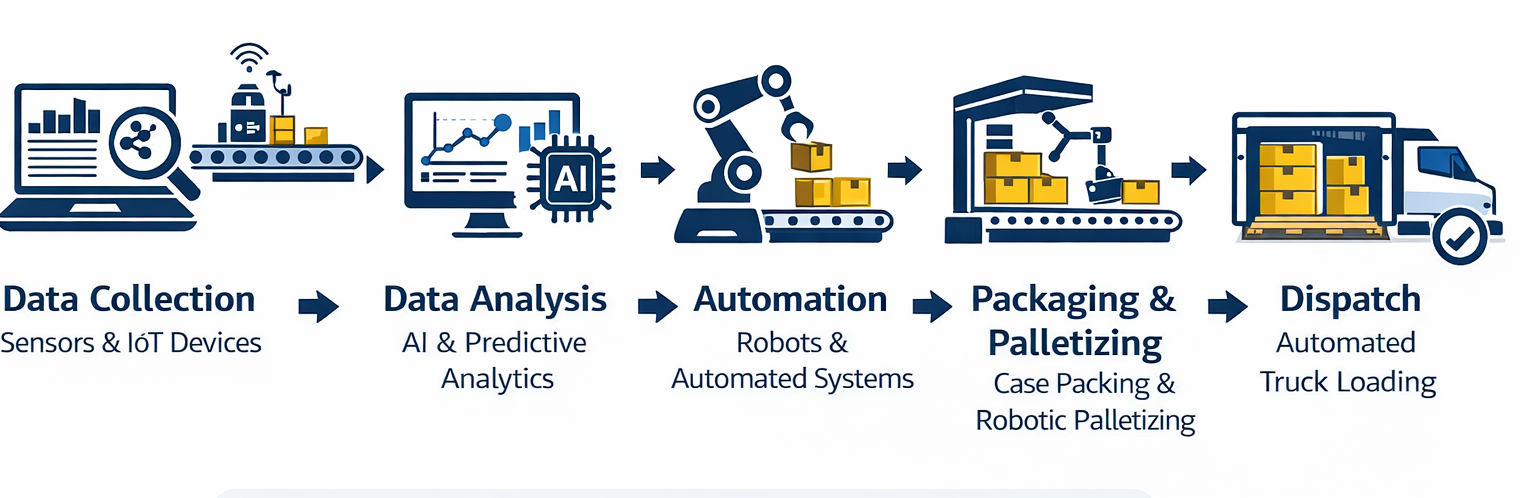
Manufacturers in ANZ are integrating cutting-edge technologies into their operations, making production faster, smarter, and more reliable. These systems are not just upgrades; they are redefining workflows.
- Robotics handling repetitive and precision-based tasks
- IoT-enabled machines for real-time monitoring
- AI-driven analytics for predictive maintenance
- Smart sensors ensuring consistent product quality
For example, many production facilities are now using palletizing systems and conveyor-based material handling solutions to automate end-of-line processes, reducing manual effort while improving throughput.
These advancements are helping manufacturers build fully connected and efficient production environments.
3. Access to a Skilled and Adaptive Workforce
A major strength of the ANZ region lies in its workforce, which is well-equipped to handle both traditional manufacturing and modern automation technologies.
- Strong technical education and training systems
- Collaboration between industries and academic institutions
- Upskilling programs focused on automation and robotics
- Workforce adaptability to new technologies
This ensures that businesses can implement smart systems effectively without facing major operational challenges.
4. Strong Focus on Sustainability and Efficiency
Sustainability is a key priority for manufacturers in ANZ, and smart manufacturing plays a crucial role in achieving these goals. Companies are focusing on reducing waste and improving resource efficiency.
- Energy-efficient production systems
- Optimized processes to minimize material waste
- Real-time tracking of energy and resource usage
- Eco-friendly manufacturing practices
Automation systems, such as optimized packaging lines and material handling conveyors, also help reduce overuse and improve operational efficiency.
This balance between sustainability and productivity is a major driver of smart manufacturing adoption.
5. Strategic Position in the Global Market
ANZ’s location provides strong access to Asia-Pacific markets, making it a valuable manufacturing and export hub. Smart manufacturing further strengthens this advantage.
- Faster and more reliable production cycles
- High-quality standards for global markets
- Improved supply chain management
- Ability to scale operations efficiently
Technologies like automated truck loading and end-of-line packaging systems are helping businesses handle higher volumes with greater speed and accuracy.
This positions ANZ manufacturers as competitive players on the global stage.
Industries Leading the Smart Manufacturing Shift
Several industries across ANZ are actively adopting smart manufacturing to stay competitive and efficient.
The food and beverage sector is using automation to maintain hygiene, ensure consistency, and speed up packaging processes. Systems like automated bagging and secondary packaging solutions are widely used to handle high production volumes with precision.
In mining and heavy industries, automation is improving safety and operational efficiency, especially through advanced material handling and logistics systems.
The healthcare and biotech sector relies on precision manufacturing, where automated systems ensure strict quality control and consistency.
Meanwhile, advanced engineering and industrial manufacturing are leveraging technologies such as robotic palletizing and intelligent conveyor systems to improve productivity and reduce manual dependency.
These industries are not just adopting smart manufacturing; they are driving its growth across the region.
How Businesses Are Benefiting from Smart Manufacturing?
The transition to smart manufacturing is delivering measurable benefits across operations, helping businesses improve both performance and profitability.
Companies are experiencing higher efficiency as automation reduces manual intervention and speeds up production cycles. Real-time monitoring systems allow quick identification of issues, minimizing downtime and maintenance costs.
Consistency in product quality is another major advantage. Automated systems ensure uniform output, even at scale. Additionally, better supply chain visibility allows businesses to manage inventory, logistics, and delivery timelines more effectively.
End-of-line automation, such as palletizing, packaging, and automated loading systems, is particularly impactful, as it connects production with dispatch, ensuring smooth and uninterrupted workflow.
Overall, businesses gain better control, improved reliability, and the ability to scale operations with confidence.
The Road Ahead for Smart Manufacturing in ANZ
Smart manufacturing is transforming the industrial landscape of Australia and New Zealand, enabling businesses to operate with greater efficiency, precision, and adaptability. The region is well on its way to becoming a global leader in advanced manufacturing.
As technology continues to evolve, manufacturers who embrace automation and data-driven systems will be better positioned to scale, innovate, and stay competitive in an increasingly demanding global market.
Why Choose Alligator Automations Australia As Your Automation Partner?
Alligator Automations offers a complete range of end-of-line automation solutions designed to simplify complex manufacturing processes and improve overall efficiency. Their systems are engineered to integrate seamlessly into existing production lines, helping businesses achieve faster operations, consistent output, and reduced manual intervention.
Key solutions include:
- Automatic Bagging Solutions
- Secondary Packaging Solutions
- Palletizing Solutions
- Intralogistics Conveyors
- Pallet Packaging Systems
- Automatic Truck Loading System
With a strong focus on performance and reliability, these solutions help manufacturers optimize workflow, enhance productivity, and build a more efficient, future-ready production environment.
Build Smarter, Faster, and More Efficient Production Lines
At Alligator Automations Australia, we help manufacturers turn complexity into efficiency with advanced automation systems designed for real-world production environments. From packaging to palletizing and material handling, our solutions are built to improve performance at every stage of the process.
If you’re ready to upgrade your operations, explore our best end-of-line automation solutions and take the next step toward smarter manufacturing.