
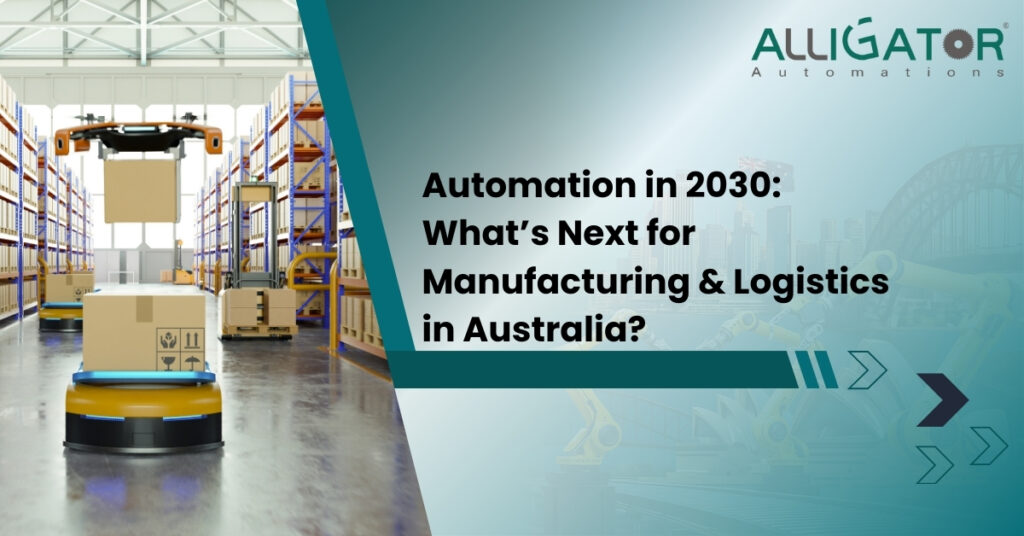
Automation in 2030: What’s Next for Manufacturing & Logistics in Australia?
Summary: By 2030, automation in Australia won’t just streamline production lines — it will redefine how manufacturers and logistics businesses plan, execute, and scale. AI-driven scheduling, autonomous warehousing, predictive maintenance, and smarter packaging workflows will move operations from reactive problem-solving to proactive, data-powered growth. The companies that win won’t simply install machines — they’ll build connected, intelligent ecosystems that continually optimize performance.
Table of Contents
Toggle
As Australia approaches 2030, automation is set to redefine manufacturing and logistics, transforming how businesses operate, scale, and compete. Advanced AI, robotics, and smart material-handling systems will go beyond simple task automation, enabling predictive decision-making, faster production, and optimized supply chains. Companies that embrace these innovations now will gain efficiency, reduce costs, and improve reliability, while those relying on traditional processes risk falling behind. The future favors connected, intelligent, and adaptive operations.
A Decade of Transition — From Mechanization to Intelligence
Australian factories and logistics hubs have already automated many repetitive tasks. The next phase is different: systems will communicate, learn, and self-adjust.
- Production lines will sync automatically with inventory and delivery schedules
- Warehouses will reorganize stock based on predicted demand
- Robots will coordinate tasks independently
- Vision systems will check quality in real time
This evolution isn’t just about reducing labour — it’s about building operations that think, adapt, and improve every day.
AI Becomes the Decision Engine
By 2030, AI will sit at the centre of operational strategy.
It will support or fully automate:
- Demand forecasting
- Workforce and shift planning
- Maintenance scheduling
- Quality inspections
- Energy optimization
With AI, manufacturers will experience fewer stoppages, shorter lead times, and more predictable outputs. As more facilities adopt automatic packaging solutions in Australia, fulfillment will become faster and more consistent, with less reliance on manual handling.
Robotics Move Beyond the Line
Collaborative robots (cobots) and autonomous mobile robots (AMRs) will become standard across production and logistics environments.
They will manage:
- Palletizing
- Case packing
- Material movement
- Order picking
Humans won’t disappear — roles will shift toward monitoring, programming, troubleshooting, and process improvement. Early adopters will gain the biggest advantage because their teams will evolve alongside the technology.
Smarter, Faster Warehousing
Warehouses are becoming digital ecosystems. By 2030, many Australian facilities will feature:
- Dynamic storage that reorganizes itself
- Automated truck loading
- Digital twins for real-time scenario testing
- IoT-connected equipment that reports performance automatically
This means fewer bottlenecks, reduced fuel use, and faster turnaround — critical for e-commerce, FMCG, agriculture, mining exports, and more.
Sustainability Becomes a Built-In Benefit
Automation’s environmental advantages are increasingly important. Smarter systems help reduce:
- Packaging waste
- Overproduction
- Energy usage
- Transportation inefficiencies
With stricter regulations and conscious consumers, automation supports both compliance and brand credibility.
Skills Will Evolve — Not Disappear
Automation doesn’t eliminate jobs — it transforms them.
High-demand roles will include:
- Robotics technicians
- Automation engineers
- Data analysts
- Process optimization specialists
Companies that reskill teams today will be the ones thriving tomorrow — especially those investing in the best end-of-line packaging solutions in Australia to stay globally competitive.
Predictive Systems Reduce Risk
Predictive analytics will anticipate problems before they happen. Machines will self-diagnose, alert teams early, and schedule maintenance during low-impact times. This creates safer workplaces, fewer breakdowns, and longer equipment lifecycles — saving millions in potential losses.
Looking Toward 2030
The most successful Australian businesses won’t just own advanced machines. They’ll operate connected, AI-driven, insight-led ecosystems that grow smarter every year. Automation will deliver:
- Faster time-to-market
- Higher product consistency
- Scalability without proportional labour costs
- Strong resilience against supply disruptions
Those planning today will be leading tomorrow.
Partnering With Alligator Automations Australia!
Alligator Automations helps Australian industries transition into this future — not with generic equipment, but with tailored, AI-enabled packaging and material-handling systems designed around real-world challenges.
We support sectors including Feed, Agriculture, Fertilizer, Minerals, FMCG, Food & Beverages, Logistics, Petrochemical, Cement, E-Commerce, Automobile, and more.
What We Deliver?
- Automatic Bagging Solutions
- Case Packaging Systems
- Palletizing Solutions
- Conveyor & Material Handling Systems
- Automatic Truck Loading Solutions
- Pallet Packaging Solutions
Why Choose Us?
- Lifetime service promise — long-term support, not one-time delivery
- Custom-engineered solutions aligned with operational goals
- Premium quality with competitive pricing
- Constant innovation driven by research
- Global experience backed by local Australian expertise
If your organisation is preparing for 2030, our team can assess your processes, estimate ROI, and design automation that scales — from pilot projects to smart-factory transformation. Let’s explore how automation can make your operations faster, safer, and future-ready.
FAQs
Will automation fully replace human labour?
No — automation reduces repetitive work while people move into supervision, technical, and quality roles.
Is automation affordable for mid-size manufacturers?
Yes. Modular systems let businesses start small and expand gradually while still gaining ROI.
How does automation improve safety?
It reduces manual lifting, repetitive strain, and hazardous workplace exposure.
Which industries benefit most by 2030?
Food & Beverages, FMCG, Agriculture, Logistics, E-Commerce, Minerals, Cement, and Petrochemical sectors show the strongest returns.
How long do automation projects take to implement?
Timelines vary, but phased rollouts allow benefits to begin early while systems expand.
Can automation integrate with existing systems?
Yes. Modern automation integrates with ERP, WMS, MES, and legacy machinery with minimal disruption.
What happens if automated equipment fails?
Predictive diagnostics detect issues early, while service support reduces downtime.
Does automation help reduce waste and energy use?
Absolutely — precision controls lower energy consumption and reduce material loss.
How does automation support sustainability targets?
By improving efficiency, minimizing rejects, and optimizing transport and resource use.
Where should businesses begin?
Start with a process assessment, identify bottlenecks, calculate ROI, and automate high-impact areas first — such as packaging, palletizing, or material handling.
Recent Posts
Categories
Browse Our Automation Solutions
Explore our complete product catalogue and find the perfect solution for your industry.