
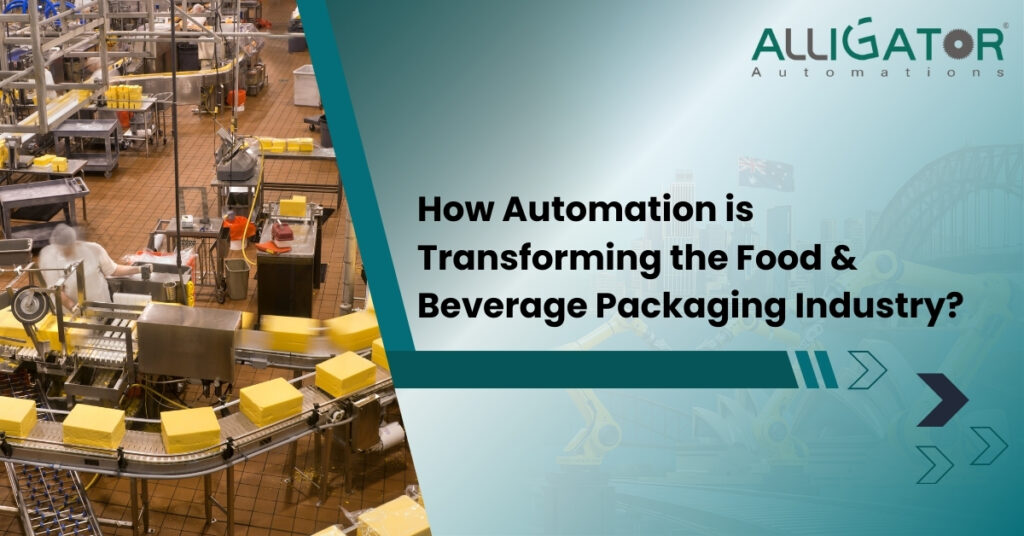
How Automation is Transforming the Food & Beverage Packaging Industry?
Summary: Automation is reshaping the food and beverage packaging industry by improving efficiency, reducing costs, enhancing product safety, and supporting sustainability. From robotic pick-and-place systems to AI-powered quality control, modern packaging lines are becoming smarter, faster, and more reliable. This blog explores key trends, benefits, real-world applications, and what the future holds for automated food packaging.
Table of Contents
ToggleThe food and beverage industry has always relied on innovation — but the last decade has seen one of its biggest shifts yet: automation.
Rising consumer demand, strict regulatory standards, labour challenges, and the need for faster production have motivated manufacturers to upgrade traditional packaging processes. Today, advanced robots, smart conveyors, vision systems, and AI analytics are working together to transform packaging lines from manual and repetitive workflows into highly efficient, automated ecosystems.
Automation is no longer just an option — it’s quickly becoming a competitive necessity.
1. Why Automation Matters in Food & Beverage Packaging
Food companies deal with massive volumes, tight delivery deadlines, and zero-tolerance quality expectations. Manual processes often struggle with:
- Human error
- Labour shortages
- Product contamination risks
- Slower turnaround times
- Higher operational costs
Automation tackles these challenges head-on, helping manufacturers:
- Maintain consistent packaging quality
- Improve food safety and hygiene
- Increase production speeds
- Reduce dependency on manual labour
- Optimize resource usage and waste
As a result, automated packaging systems deliver both economic and operational benefits.
2. Key Automation Technologies Transforming Packaging
Robotics & Cobots
Robotic arms and collaborative robots (cobots) are increasingly used for:
- Pick-and-place operations
- Case packing
- Palletizing
- Sorting and loading
Cobots work safely alongside human workers, handling repetitive or heavy tasks — boosting efficiency while reducing workplace fatigue and injuries.
Automated Filling & Sealing Machines
Precision filling machines ensure accurate portioning for liquids, powders, and solids. Automated sealing systems guarantee airtight packaging, maintaining product freshness and extending shelf life. These machines reduce product waste and improve speed without compromising hygiene standards.
Vision Inspection & AI Quality Control
Machine vision systems equipped with AI can detect:
- Packaging defects
- Incorrect labelling
- Seal integrity failures
- Contaminants
- Barcode errors
Automated inspection is faster and more accurate than manual checks — ensuring every product leaving the facility meets compliance and quality standards.
Smart Conveyors & Material Handling
Automated conveyors, AGVs (Automated Guided Vehicles), and smart storage systems move materials seamlessly across production lines. They ensure smoother workflows, minimize downtime, and eliminate bottlenecks.
Track-and-Trace Systems
Barcode and RFID technologies make it easier to track products through the entire supply chain. This enables:
- Faster recalls (if necessary)
- Better inventory management
- End-to-end transparency
Consumers today value traceability — and automation makes it possible at scale.
3. Benefits of Automation for Manufacturers
Higher Productivity
Automated systems can run 24/7 with minimal supervision, dramatically increasing throughput.
Improved Food Safety
Reduced human contact limits contamination risks — aligning with stringent food safety regulations.
Cost Savings
Although the initial investment may seem high, long-term savings come from:
- Less waste
- Lower labour expenses
- Fewer product recalls
- Optimized resource usage
Consistent Quality
Automation ensures uniform packaging, improving brand reliability and consumer trust.
Scalability
Manufacturers can easily expand automated lines as demand grows — without major process disruption.
4. Automation and Sustainability
Sustainability is now a major focus across the food industry. Automation supports eco-friendly operations by:
- Minimizing material usage
- Reducing energy consumption
- Optimizing packaging design
- Lowering product waste through accuracy
Smart packaging lines help companies meet environmental regulations and demonstrate commitment to greener manufacturing.
5. Challenges — and How Companies Overcome Them
Like any transformation, automation brings challenges:
- Initial capital investment
- Need for skilled technicians
- Integration with existing systems
However, companies adopting phased automation and working with expert solution providers are experiencing faster ROI and smoother transitions. The key is choosing the right technology partner — one that understands both automation engineering and the unique needs of food and beverage operations.
6. The Future of Automated Packaging
The future will be increasingly connected and data-driven. Expect advancements such as:
- AI-powered predictive maintenance
- Fully autonomous production lines
- Digital twins for real-time simulation
- More flexible packaging machines for multiple SKUs
- Greater integration with IoT and cloud data systems
Automation is evolving from individual machines to fully intelligent ecosystems. Businesses that embrace this shift will operate faster, safer, and more profitably — while delivering better quality to consumers.
A Practical Takeaway for Food & Beverage Manufacturers!
Automation is revolutionizing the food and beverage packaging industry — from efficiency and quality control to safety and sustainability. Manufacturers adopting automatic packaging solutions in Australia are achieving measurable competitive advantages and preparing themselves for future growth. Those who continue relying solely on manual processes risk inefficiencies, higher costs, and inconsistent quality — while automated facilities move ahead.
Partner with Australia’s Packaging Automation Leader — Alligator Automations
Alligator Automations is a trusted Australian leader in packaging automation, delivering state-of-the-art, AI-driven systems designed to streamline production, cut labour dependency, and boost operational efficiency. We serve diverse industries including Feed, Agriculture, Fertilizer, Minerals, FMCG, Food & Beverages, Petrochemical, Cement, E-Commerce, Logistics, and Automobile — and many more.
Our advanced solutions include:
- Automatic Bagging Solutions
- Case Packaging Systems
- Palletizing Solutions
- Conveyor & Material Handling Systems
- Automatic Truck Loading Solutions
Why manufacturers choose Alligator Automations
- Lifetime Service Promise – long-term support that keeps your lines running smoothly.
- Tailor-Made Engineering – every solution is designed specifically for your plant and production goals.
- Premium Quality, Competitive Pricing – world-class systems that deliver lasting value.
- Innovation at the Core – robotics, AI, and automation engineered for the factories of tomorrow.
With global offices and proven expertise, Alligator Automations helps industries worldwide maximize productivity, improve safety, and scale confidently.
👉 Ready to upgrade your packaging line? Let’s engineer a smarter, fully automated future together.
Contact Alligator Automations Australia today.
FAQs
Is automation suitable for small and mid-sized food companies?
Yes. Automation can be implemented gradually. Even small upgrades — like automated labelling or inspection — can deliver big efficiency and cost benefits.
Does automation replace human workers completely?
Not usually. Automation reduces repetitive manual labour, while workers shift to supervision, quality control, and technical roles.
How long does it take to see ROI on packaging automation?
Most companies start seeing returns within 1–3 years, depending on production scale and system complexity.
Are automated systems difficult to maintain?
Modern systems are built with diagnostics and predictive alerts. With proper training and service support, maintenance is easier than traditional machinery.
Can automated packaging support sustainability initiatives?
Absolutely. Automation helps minimize material waste, reduce energy consumption, and ensure optimized packaging — supporting sustainability goals.
Recent Posts
Categories
Browse Our Automation Solutions
Explore our complete product catalogue and find the perfect solution for your industry.