
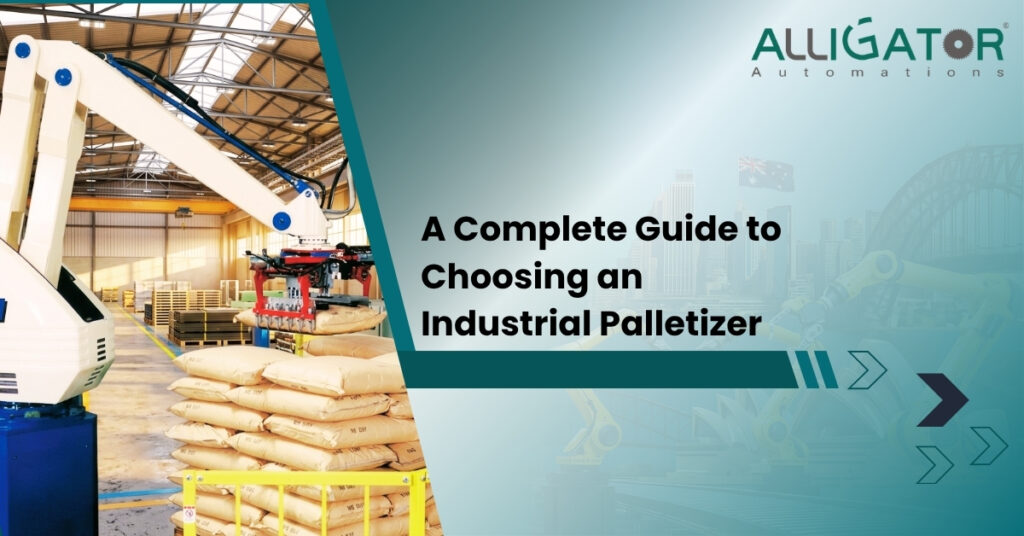
A Complete Guide to Choosing an Industrial Palletizer
Summary: Selecting the right industrial palletizer is critical to maximizing end-of-line packaging efficiency. This comprehensive guide breaks down the essential factors—such as throughput speed, payload capacity, facility footprint, and flexibility—to help you choose the ideal system for your manufacturing operations.
Table of Contents
ToggleEnd-of-line packaging is the final hurdle before your products hit the supply chain. If this stage is slow, inconsistent, or heavily reliant on manual labor, it bottlenecks your entire manufacturing facility. Investing in automated machinery is the proven path forward, but choosing the wrong setup can lead to expensive integration headaches, underutilized equipment, or unfulfilled throughput goals.
Industrial palletizers are not one-size-fits-all solutions. The optimal machine for a high-speed beverage canning plant looks drastically different from one required by a pet food factory handling heavy, shifting bags. To future-proof your investment, you must systematically evaluate your production data, space limitations, and future product roadmaps. This guide serves as a strategic manual to navigating the decision-making process.
Essential Criteria for Selecting an Industrial Palletizer
To narrow down your options from the vast market of automated material handling machinery, you must start with a deep dive into your current and projected operational metrics.
1. Product Type and Packaging Material
The physical characteristics of what you are stacking dictate the type of palletizer and the specific tooling required.
- Rigid Cartons and Corrugated Boxes: These are easily handled by standard vacuum tools or top-load conventional machinery because of their flat surfaces.
- Heavy, Non-Rigid Bags: Products like cement, soil, or grains shift during transit. They require mechanical fork grippers or bottom-flap conventional layer formers to ensure the bag is securely supported without breaking.
- Pails, Drums, and Crates: These irregular payloads often require specialized mechanical clamps or magnetic grippers to handle heavy weights securely.
2. Throughput and Speed Requirements
Palletizer speed is typically measured in Cases Per Minute (CPM) or Layers Per Minute (LPM). You need to calculate your peak production speed, not just the daily average. If your manufacturing line outputs 40 cases per minute at peak capacity, a collaborative robot handling 8 to 12 cases per minute will cause an immediate bottleneck. Conversely, buying a high-speed, 60 CPM conventional layer palletizer for a slow, 15 CPM production line is an inefficient allocation of capital.
3. Payload and Total Mass Capacity
Every machine has a strict maximum payload limit. This limit must account for the maximum weight of a single product unit plus the weight of the End-of-Arm Tooling (EOAT) itself. If you are picking up multiple cases at once to boost throughput (multi-pick configurations), the combined mass must fall safely within the machine’s payload envelope to avoid premature motor wear or structural failure.
4. Footprint and Spatial Constraints
Your facility’s layout is a hard constraint. Traditional conventional palletizers and large industrial articulated arms require significant floor space, dedicated safety fencing, and generous overhead clearance. If your floor space is limited or tucked into a tight corner near a loading dock, a compact collaborative robot (cobot) or an overhead gantry system might be the only viable choice.
Comparing the Core Palletizer Technologies
Industrial palletizers generally fall into distinct categories, each offering unique strengths depending on your manufacturing volume and flexibility needs.
Traditional Conventional Palletizers
Conventional systems receive packages from a high-speed conveyor, orient them using turning devices, and form an entire horizontal layer of product on a sliding apron before depositing it onto the pallet.
- Best for: Ultra-high-speed operations (exceeding 40 to 50 CPM), uniform product dimensions, and long, dedicated production runs with minimal product changeovers.
- Limitation: They have a very large physical footprint, require complex mechanical reconfigurations to alter stacking patterns, and struggle with highly fragile or irregular items.
Articulated Robotic Palletizers
These systems utilize multi-axis industrial robotic arms equipped with customized grippers to pick up individual items or groups of items and precisely arrange them on a pallet.
- Best for: High-to-medium speeds (up to 30 to 40 CPM), multi-line palletizing (one robot handling multiple production lines simultaneously), and environments requiring frequent pattern shifts.
- Limitation: They require a moderate footprint and robust safety guarding (fencing, light curtains, or scanner zones) to isolate the high-speed machinery from human workers.
Gantry Palletizers
Gantry systems operate on a Cartesian (linear overhead) grid. They pick products from an infeed conveyor and place them in programmable patterns.
- Best for: Lifting extremely heavy payloads (up to 500 kg), space optimization (compact vertical footprint), and managing multiple placements per minute.
- Limitation: Generally slower raw case-per-minute speeds compared to articulated multi-axis robots or conventional layer formers.
Critical Technical Details to Verify
Before signing off on a capital expenditure, your engineering team must scrutinize two fundamental technical components: software integration and tooling adaptability.
Software Interface and Recipe Selection
A flexible system should feature an intuitive Human-Machine Interface (HMI) that permits operators to adjust parameters seamlessly. Modern palletizing software utilizes visual drag-and-drop pattern builders. If your business introduces a new box size next year, your floor operators should be able to configure the new “recipe” via a touch screen in a few minutes, rather than waiting for an external software engineer to rewrite lines of code.
End-of-Arm Tooling (EOAT) Versatility
The gripper is the actual point of contact with your product. If your facility processes varying types of packaging on the same line, consider multi-functional or quick-change tooling. For example, a hybrid gripper can utilize vacuum suction pads for boxes while integrating mechanical side clamps to handle layer sheets and empty pallets without requiring a physical tool swap.
Crafting Your Automation Strategy!
Choosing an industrial palletizer requires a balanced evaluation of your immediate production metrics, your floor space constraints, and your long-term business scale. While conventional palletizers remain unmatched in raw, uniform speed, articulated robotic arms and heavy-duty gantry systems offer the modular flexibility demanded by modern supply chains. By carefully mapping out your case dimensions, peak throughputs, and payload demands, you can invest confidently in a system that maximizes operational efficiency and delivers a rapid return on investment.
Partner with Australia’s Automation Experts
Navigating the complexities of end-of-line integration is simpler with expert guidance. For custom-engineered, robust automated material handling and packaging systems tailored precisely to your facility’s operational goals, explore the cutting-edge engineering solutions at Alligator Automations Australia.
Alligator Automations is a turnkey provider of end-of-line packaging machinery, taking your facility from concept to commissioning. They specialize in overcoming complex process challenges to improve productivity, reduce labor dependency, and enhance workplace safety.
Complete Palletizing Solutions
Whether you are dealing with high-volume uniform cartons or heavy, shifting bags of raw materials, Alligator Automations offers a comprehensive suite of palletizing systems designed to adapt to your specific payload:
- Robotic Palletizing: Advanced, multi-axis robotic arms equipped with customized End-of-Arm Tooling. Handle multiple conveyor lines, diverse SKUs, and complex stacking patterns with flawless precision.
- Gantry Palletizing: Heavy-duty, space-efficient Cartesian systems designed to lift massive payloads (up to 500kg) that standard robotic arms cannot support.
- High-Level Palletizing: High-speed, push-type conventional systems featuring continuous overhead row pushers and compactors. The industry standard for tightly compacting and securing heavy bags.
- Low-Level Palletizing: Floor-level conventional palletizers that easily integrate with existing ground-level conveyors, offering safe, easy operator access and simplified maintenance.
- Hybrid Palletizing: A highly versatile solution that combines the smart flexibility of a robotic arm with the powerful layer-compaction of a high-level system.
- Robotic Depalletizing: Automated systems utilizing advanced vision technology to identify, grip, and cleanly unload inbound mixed-SKU pallets without damaging the primary packaging.
Beyond Palletizing: End-to-End Automation
To ensure every link in your production chain is optimized, Alligator Automations provides a full ecosystem of interconnected secondary packaging machinery:
- Automatic Bagging Solutions: Precision open-mouth and FIBC jumbo bag filling systems.
- Secondary Packaging: Automated case packing and bag-in-bag solutions.
- Pallet Packaging Systems: Advanced stretch wrapping, strapping, stretch hooding, and thermo-shrinking machinery to secure your finalized loads.
- Intralogistics Conveyors: Smart motorized roller, belt, and heavy-duty pallet conveyor networks designed to safely orchestrate traffic across your warehouse floor.
- Automatic Truck Loading Systems (ATLS): High-speed automated dock loading solutions that push fully formed pallets directly into standard trailers, eliminating loading dock bottlenecks in minutes.
Transform your packaging productivity today. Discover their full range of products and connect with their engineering team at Alligator Automations Australia.
Frequently Asked Questions
What are the main types of industrial palletizers?
The primary types are conventional (layer-forming) palletizers (high-level and low-level), articulated robotic palletizing arms, and gantry palletizers. Each scales differently in terms of speed, footprint, and flexibility.
How do I determine if I need a conventional or a robotic palletizer?
Choose a conventional palletizer if you have ultra-high throughput demands (over 40 to 50 cases per minute) and run single, uniform product lines. Choose a robotic or gantry palletizer if you handle varying box sizes, require complex stacking patterns, or need a single machine to handle multiple conveyor lines simultaneously.
What is "Cases Per Minute" (CPM) and why is it important?
CPM measures how many individual product units a palletizer can process and stack within a single minute. Accurately measuring your production line’s peak CPM ensures you purchase a machine that will not bottleneck your facility.
What is End-of-Arm Tooling (EOAT)?
EOAT refers to the gripper, clamp, or vacuum mechanism attached to the end of a robotic arm. It is the component that physically interacts with your product, and it must be custom-matched to your packaging material (e.g., bags vs. boxes).
Can a robotic palletizer place slip sheets and empty pallets?
Yes. Many robotic systems feature versatile or hybrid grippers that can use vacuum suction to lay down a cardboard slip sheet, mechanical clamps to fetch a fresh wooden pallet from a dispenser, and then immediately resume stacking products.
What is a Hybrid Palletizer?
A hybrid palletizer combines the precise picking and arranging capabilities of a multi-axis robotic arm with the layer-compaction and squaring mechanics of a conventional high-level palletizer. It is ideal for ensuring highly stable pallets of non-uniform or shifting bags.
What is a "recipe" in automated palletizing?
A recipe is a pre-programmed software configuration stored within the machine’s control system. It defines the specific dimensions, layer orientations, and stacking patterns for a specific product type, allowing operators to switch production lines instantly via a touchscreen
Do palletizing robots require specialized programmers to operate daily?
No. While initial installation requires engineering setup, modern industrial palletizers feature user-friendly HMIs. Daily operators can change product configurations, select patterns, and troubleshoot basic alerts using visual menus without any programming background.
What safety standards must industrial palletizers meet?
In Australia, industrial automated systems must comply with stringent workplace safety standards, including AS/NZS 4024. Traditional high-speed robots and gantry systems require physical perimeter fencing, light curtains, or safety laser scanners to ensure the machine stops instantly if a human enters the work zone.
Can a palletizer handle fragile or loosely packed products?
Yes. Robotic palletizers with specialized vacuum arrays distribute lifting force evenly across flat surfaces, preventing crushing. For fragile or loose items, side-clamp or bottom-support mechanical grippers ensure the product is safely cradled during transit.
Recent Posts
Categories
Browse Our Automation Solutions
Explore our complete product catalogue and find the perfect solution for your industry.