
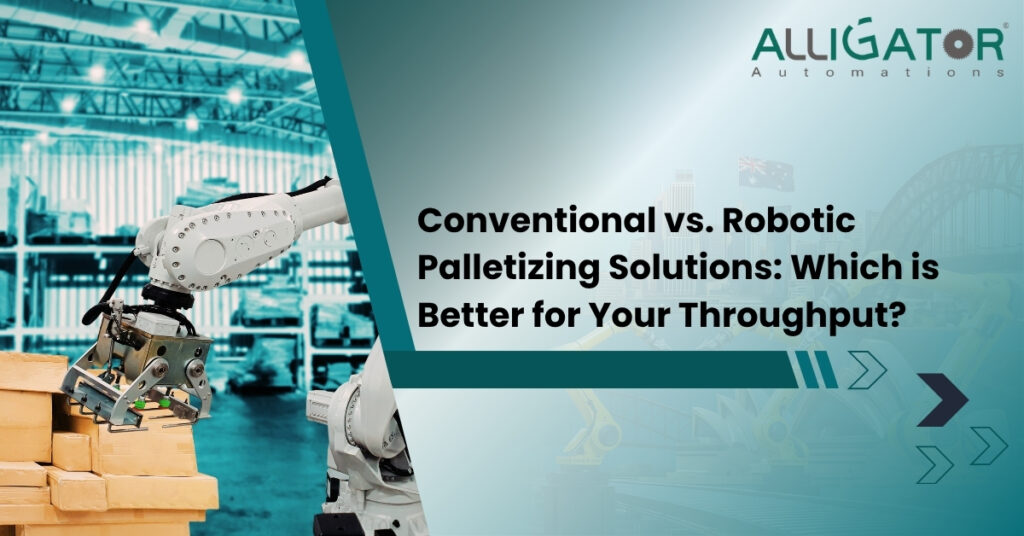
Conventional vs. Robotic Palletizing Solutions Which is Better for Your Throughput?
Summary: Choosing between conventional and robotic palletizing solutions is one of the most important decisions for manufacturers, warehouses, and logistics facilities aiming to improve throughput and operational efficiency. While conventional palletizers are known for handling high-speed repetitive tasks, robotic palletizers offer flexibility, precision, and adaptability for modern production environments. Understanding the strengths and limitations of each system can help businesses select the right solution based on production volume, SKU variety, labor availability, and long-term scalability.
Table of Contents
ToggleIn today’s fast-paced manufacturing and logistics industries, palletizing has become a critical part of end-of-line automation. Businesses are under constant pressure to improve efficiency, reduce labor dependency, and increase throughput without compromising product quality or workplace safety.
This is where the debate between conventional palletizing systems and robotic palletizing solutions becomes important. Both technologies are designed to automate the stacking of products onto pallets, but they differ significantly in terms of speed, flexibility, maintenance, scalability, and overall operational value.
The best choice depends on your production goals, product mix, facility layout, and future expansion plans.
What is Conventional Palletizing?
Conventional palletizing uses mechanical systems such as conveyors, pushers, layer-forming devices, and elevators to stack products onto pallets in a predefined pattern. These systems are commonly found in high-volume industries such as food processing, beverages, and consumer packaged goods.
Conventional palletizers are typically designed for repetitive operations involving uniform products and consistent pallet patterns. They excel in environments where speed is the highest priority.
These systems can process extremely high case volumes and are often preferred for single-SKU operations requiring maximum throughput.
What is Robotic Palletizing?
Robotic palletizing uses robotic arms equipped with advanced grippers or end-of-arm tooling to pick and place products onto pallets. These systems are programmable and highly adaptable, making them ideal for facilities handling multiple product types, changing pallet configurations, and mixed-SKU operations.
Modern robotic palletizers can quickly switch between product lines through software programming instead of mechanical adjustments. This flexibility has made robotic systems increasingly popular across warehousing, e-commerce, pharmaceuticals, agriculture, and manufacturing industries.
Robotic palletizers are particularly effective for handling difficult products such as bags, pails, cartons, and irregularly shaped packages.
Throughput Comparison: Which System Performs Better?
Throughput is often the deciding factor when selecting a palletizing solution. However, throughput is not just about raw speed. It also includes uptime, changeover efficiency, consistency, and overall operational flow.
Conventional Palletizers for Maximum Speed
When it comes to pure speed, conventional palletizers generally outperform robotic systems. Some high-speed conventional palletizers can process over 200 cases per minute in optimized environments.
These systems are ideal for:
- High-volume production lines
- Repetitive packaging operations
- Single-product manufacturing
- Stable production schedules
- Minimal SKU variation
Because conventional palletizers are mechanically optimized for specific product flows, they can maintain exceptional throughput with minimal interruptions.
For example, beverage manufacturers or large FMCG facilities often rely on conventional systems because they handle large quantities of uniform packages continuously throughout the day.
Robotic Palletizers for Flexible Throughput
While robotic palletizers may not always match the top speed of conventional systems, they provide superior throughput efficiency in facilities handling diverse products.
Robotic systems minimize downtime during changeovers because adjustments are software-based rather than mechanical. This means businesses can switch between SKUs, pallet patterns, and packaging formats much faster.
Robotic palletizers are ideal for:
- Mixed-product operations
- Frequent product changes
- Seasonal production shifts
- Custom pallet configurations
- Multi-line palletizing
Many businesses find that overall productivity improves with robotics because reduced downtime offsets slightly slower pick rates.
Flexibility and Adaptability
Modern supply chains increasingly demand flexibility. Consumer preferences change quickly, product varieties continue growing, and businesses must adapt faster than ever.
This is where robotic palletizing stands out.
Conventional palletizers often require physical modifications when changing product dimensions or pallet patterns. These adjustments can increase downtime and operational complexity.
Robotic systems, however, can store multiple palletizing programs and switch between them instantly. Operators can modify stacking patterns directly through the control system without significant mechanical intervention.
For facilities producing multiple SKUs daily, robotic palletizing offers a major operational advantage.
Labor and Workplace Safety
Labor shortages and rising labor costs are pushing companies toward automation. Manual palletizing is physically demanding and increases the risk of workplace injuries such as back strain, repetitive motion injuries, and fatigue.
Robotic palletizers improve workplace safety by reducing heavy lifting and repetitive tasks. They also maintain consistent performance throughout long shifts without fatigue-related slowdowns.
Conventional palletizers also reduce labor dependency, but robotic systems generally require fewer manual interventions in flexible production environments.
Space Requirements
Floor space is another important consideration.
Conventional palletizers are often designed as integrated systems and can sometimes occupy less operational space for dedicated production lines. However, they may require extensive conveyor systems and product staging areas.
Robotic palletizers can offer compact layouts, especially when servicing multiple production lines from a single robotic cell. Their flexibility makes them suitable for facilities with changing layouts or future expansion plans.
Maintenance and Operational Complexity
Conventional palletizers are generally simpler mechanically and may require less specialized programming knowledge. They are often easier to maintain in facilities with traditional maintenance teams.
Robotic palletizers involve advanced software, sensors, and robotic programming, which can increase technical complexity. However, modern robotic systems are becoming increasingly user-friendly and reliable.
Many facilities consider the long-term benefits of reduced labor costs, improved flexibility, and scalability worth the additional technical investment.
Which Industries Benefit Most from Conventional Palletizing?
Conventional palletizing is usually the better choice for:
- Beverage manufacturing
- High-speed food processing
- Bulk packaging operations
- Facilities with single-SKU production
- Large-scale repetitive manufacturing
These industries prioritize uninterrupted speed and consistent output above operational flexibility.
Which Industries Benefit Most from Robotic Palletizing?
Robotic palletizing is often the better fit for:
- E-commerce fulfillment
- Pharmaceutical packaging
- Agriculture and feed industries
- Warehousing and logistics
- Multi-product manufacturing
- Facilities with changing pallet patterns
These operations require adaptability, precision, and rapid product changeovers.
Cost Considerations
Conventional palletizers may have lower initial costs for dedicated high-speed applications. However, modifications and future upgrades can become expensive over time.
Robotic palletizers typically involve higher upfront investment, but they often deliver better long-term ROI through:
- Reduced labor costs
- Lower injury risks
- Faster changeovers
- Increased operational flexibility
- Easier scalability
As automation technology becomes more accessible, robotic palletizing is becoming increasingly cost-effective for medium-sized operations as well.
Choosing the Right Solution for Long-Term Efficiency
There is no universal answer because the best palletizing solution depends entirely on your operational requirements.
If your facility runs high-speed production lines with minimal product variation, conventional palletizing may deliver the highest throughput.
If your operation handles multiple SKUs, changing packaging formats, and variable production schedules, robotic palletizing will likely provide better long-term throughput efficiency and flexibility.
In many modern facilities, hybrid solutions are also emerging, combining the speed of conventional systems with the adaptability of robotics.
The future of palletizing is increasingly focused on intelligent automation, flexibility, and scalability. Businesses that carefully evaluate their production goals, throughput demands, labor challenges, and expansion plans will be better positioned to select the right palletizing system.
Businesses exploring the best robotic palletizing solutions in Australia can benefit from advanced automation systems designed to improve throughput, reduce labor dependency, and support scalable warehouse operations.
Whether you choose conventional or robotic palletizing, investing in the right automation solution can significantly improve productivity, workplace safety, and long-term operational efficiency.
Recent Posts
Categories
Browse Our Automation Solutions
Explore our complete product catalogue and find the perfect solution for your industry.