
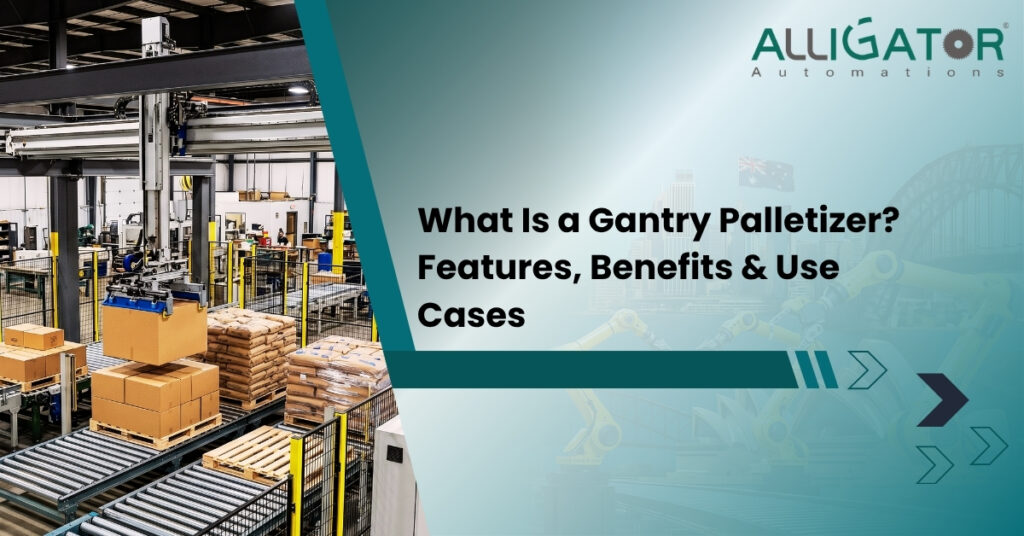
What Is a Gantry Palletizer? Features, Benefits & Use Cases
Summary: A gantry palletizer is a Cartesian-motion automated system that stacks products onto pallets using a rigid overhead frame structure. Unlike robotic arm palletizers, gantry systems move in linear X, Y, and Z axes, making them exceptionally precise, fast, and ideal for high-volume industrial environments. This blog covers everything you need to know — from how they work and key features to real-world use cases and why Alligator Automations is Australia’s trusted partner for gantry palletizing solutions.
Table of Contents
ToggleEfficiency at the end of the production line is not a luxury — it is a competitive necessity. Businesses across food and beverage, agriculture, chemicals, cement, and logistics are under constant pressure to move more product, reduce labour dependency, and minimise errors. Manual palletizing, once a staple of factory floors, simply cannot keep up.
This is where gantry palletizers come in. Robust, precise, and purpose-built for demanding industrial environments, gantry palletizers have become a cornerstone of modern end-of-line automation. Whether you are stacking 25 kg bags of fertilizer, cartons of bottled beverages, or bales of animal feed, a gantry palletizer can do it faster, safer, and more consistently than any manual process.
In this blog, we break down exactly what a gantry palletizer is, how it works, what features to look for, the industries it serves best, and why Alligator Automations is the partner of choice for businesses in Australia and beyond.
What Is a Gantry Palletizer?
A gantry palletizer is an automated palletizing machine that uses a rigid overhead gantry frame to guide a product-handling head across three linear axes — X (horizontal), Y (lateral), and Z (vertical). Unlike a robotic arm palletizer that operates with rotational joints, the gantry system travels in straight lines, making it inherently precise and structurally stable even under heavy loads.
The machine picks up products — bags, boxes, cartons, bundles, or trays — from an infeed conveyor and places them in a pre-programmed pattern on a pallet below. The gantry structure spans the entire working area, allowing the system to cover a large footprint without any loss of reach or accuracy.
Gantry palletizers are commonly used in applications where high throughput, heavy payloads, and consistent stacking patterns are non-negotiable. They are particularly well-suited to environments where products are uniform in size and the production volume is continuous and predictable.
How Does a Gantry Palletizer Work?
The Infeed and Product Orientation Stage
Products arrive via conveyor from the upstream packaging line. Depending on the application, products may pass through a bag flattener, an orientation module, or a turntable that ensures every item is correctly aligned before it reaches the pick zone. Consistent orientation at this stage is critical to achieving a clean, stable pallet stack.
The Pick and Place Cycle
The gantry head equipped with a gripper, clamp, or vacuum tool depending on the product type descends to pick each product or row of products from the infeed station. It then travels along the gantry rails to the pallet position and places the product precisely according to the programmed layer pattern. The cycle repeats until each layer is complete, and the Z-axis lifts the head to begin the next layer.
Pallet Handling and Changeover
Once a pallet is fully stacked, the system signals the pallet conveyor to move the completed pallet out to the stretch wrapping or dispatch area, and a fresh empty pallet is automatically fed in. This seamless changeover is what enables gantry palletizers to run continuously without stopping the upstream line.
What Are the Key Features of a Gantry Palletizer?
High-Speed Linear Motion
Because gantry systems move in straight lines rather than arcs, they are extremely fast and predictable. Cycle times can be optimised to match even the fastest bagging or filling lines, ensuring zero bottlenecks at the end of the production process.
Heavy Payload Capacity
Gantry palletizers are built to handle serious weight. They are commonly used for products ranging from 10 kg to 50 kg per unit, making them the go-to solution for industries like cement, fertilisers, animal feed, and construction materials where individual bag weights are high.
Flexible Layer Pattern Programming
Modern gantry palletizers are controlled via PLC systems with touchscreen HMIs, allowing operators to programme multiple stacking patterns and switch between them quickly. Different products, bag sizes, or customer requirements can each have their own saved pattern, reducing changeover time to minutes.
Robust Structural Design
The gantry frame is engineered for industrial environments — dust, vibration, temperature variation, and continuous operation are all accounted for in the design. Heavy-gauge steel construction and precision linear guides ensure the system maintains positional accuracy over years of high-cycle operation.
Integrated Safety Systems
Gantry palletizers include full perimeter guarding, light curtains, emergency stop systems, and access interlocks as standard. These safety features protect operators working in proximity to the system and ensure compliance with Australian workplace health and safety standards.
Multi-Line Capability
A single gantry palletizer can often serve two or more infeed lines simultaneously, switching between them according to production demand. This makes them highly cost-effective when a facility runs multiple product lines that do not all operate at full capacity at the same time.
What Are the Real Benefits of Using a Gantry Palletizer?
Reduced Labour Costs and Dependency
Manual palletizing is physically demanding and labour-intensive. A gantry palletizer replaces multiple operators per shift, delivering immediate savings in wages, workers’ compensation exposure, and recruitment costs. In Australia’s tight labour market, this alone justifies the investment for many operations.
Improved Pallet Stability and Load Integrity
Automated stacking produces consistent, repeatable layer patterns that are structurally superior to hand-built pallets. Tighter stacking means fewer incidents of product falling in transit, reduced product damage, and improved presentation to retail and distribution customers.
Higher Throughput Without Fatigue
A gantry palletizer runs at full speed from the first shift to the last, seven days a week if required. There is no performance dip at the end of a shift, no sick days, and no slowdown during peak periods. This reliability translates directly into higher output and better on-time delivery performance.
Long-Term Return on Investment
While the upfront cost of a gantry palletizer is significant, the payback period is typically measured in months rather than years when factoring in labour savings, reduced product damage, and increased throughput. Over a ten-year operational life, the financial return is substantial.
Safer Workplace
Repetitive heavy lifting is one of the leading causes of musculoskeletal injury in industrial settings. Removing this task from the human workforce eliminates a major source of workplace injury claims and creates a safer, more sustainable working environment.
Industries and Use Cases for Gantry Palletizers
Food and Beverage
From flour and sugar to pet food and dairy powders, food manufacturers rely on gantry palletizers to handle high-speed bag and carton stacking with hygiene-compliant materials and designs. Washdown-rated configurations are available for wet processing environments.
Agriculture and Agro Commodities
Bagging lines for grain, rice, seeds, and fertilisers produce large volumes of heavy bags that demand reliable automated stacking. Gantry palletizers handle 25 kg and 50 kg woven bags with ease and can manage products with irregular fill consistency.
Cement and Building Materials
Few applications are as demanding as cement palletizing. Abrasive dust, heavy bags, and continuous high-speed production make this one of the toughest environments for any machine. Gantry palletizers are specifically designed to thrive in these conditions.
Chemicals and Fertilisers
Chemical facilities require palletizing solutions that can handle corrosive environments and maintain strict layer integrity for hazardous goods transport compliance. Gantry systems meet these demands while offering the safety separation between operators and products.
Minerals and Mining Products
Sand, coal, litter and other mineral products are bagged and palletized in high volumes. The gantry palletizer’s payload strength and durability make it ideal for these abrasive, high-throughput applications.
FMCG and Logistics
Fast-moving consumer goods facilities benefit from the gantry palletizer’s multi-line capability and rapid pattern changeover, allowing a single machine to serve diverse product SKUs across a shared end-of-line area.
Why Choose Alligator Automations for Your Gantry Palletizer?
Australia’s Trusted End-of-Line Automation Specialist Alligator Automations is one of Australia’s leading names in industrial packaging automation, with a proven track record across 14+ countries and hundreds of successfully commissioned projects including gantry palletizing installations across food, agriculture, chemicals, and heavy industry.
Built to Australian Standards Every gantry palletizer delivered by Alligator Automations is engineered to meet Australian workplace health and safety standards and local compliance requirements, giving facility managers full confidence in regulatory alignment from day one.
Fully Customised System Design No two production lines are identical. Alligator Automations designs each gantry palletizer around your specific product type, bag or carton weight, throughput speed, floor layout, and budget ensuring the system fits your operation, not the other way around.
Complete Project Management, Start to Finish From initial consultation and engineering design through to installation, commissioning, and operator training, Alligator Automations manages the entire project lifecycle. You deal with one accountable team throughout the process.
Competitive Cost-to-Engineering Ratio Alligator Automations delivers world-class automation engineering at a price point that genuinely suits the Australian market. Their value proposition — best affordable automation with unparalleled engineering quality is a key reason clients choose them over global competitors.
Full Palletizing Portfolio for Objective Recommendations Because Alligator Automations offers the complete range gantry, robotic, high level, low level, and hybrid palletizers their recommendation is always based on what is right for your facility, not what is easiest to sell.
Trusted by Global Industry Leaders Clients including Cargill, PepsiCo, Shell, HMEL, and Carlsberg have relied on Alligator Automations to deliver automation solutions that perform under real industrial conditions, a testament to the reliability and engineering quality behind every system.
Dedicated Local Support in Australia With a local team based in New South Wales and led by experienced regional specialists, Alligator Automations provides responsive on-the-ground support that global-only suppliers simply cannot match.
Long-Term After-Sales Partnership The relationship does not end at commissioning. Alligator Automations offers ongoing service contracts, spare parts availability, system upgrades, and technical training to ensure your gantry palletizer continues to deliver peak performance year after year.
Proud Member of APPMA As a proud member of the Australian Packaging and Processing Machinery Association, Alligator Automations is embedded in Australia’s packaging and processing ecosystem committed to industry best practices, innovation, and long-term customer success.
Ready to Automate Your Palletizing Line?
If your facility is still relying on manual palletizing or running an aging system that can no longer keep pace — now is the time to explore what a modern gantry palletizer can do for your operation. Alligator Automations is ready to help you assess your requirements, design the right solution, and deliver a system that performs from day one.
Contact the Alligator Automations team today at www.alligatorautomations.com.au, call +61 428 724 441, or email [email protected] our team to request an obligation-free consultation. Let Australia’s automation specialists put their engineering expertise to work for your business.
Frequently Asked Questions About Gantry Palletizers
What is the difference between a gantry palletizer and a robotic palletizer?
A gantry palletizer moves in straight linear axes using an overhead frame, while a robotic palletizer uses a multi-joint arm with rotational movement. Gantry systems generally offer higher payload capacity and structural rigidity, while robotic systems offer greater flexibility and a smaller footprint.
How fast can a gantry palletizer operate?
Depending on the model and product type, gantry palletizers can typically handle between 600 and 2,400 bags or cartons per hour. Speed is matched to the upstream production line to prevent bottlenecks.
What product types can a gantry palletizer handle?
Gantry palletizers can handle filled bags, open-mouth bags, cartons, cases, buckets, and bundles. The end-of-arm tooling is selected based on the specific product type and weight.
How much floor space does a gantry palletizer require?
This varies by model and configuration, but gantry palletizers generally require a larger footprint than robotic systems. However, their vertical build means they work well in facilities with high ceilings and defined end-of-line zones.
Can a gantry palletizer serve multiple production lines?
Yes. Many gantry configurations are designed to receive product from two or more infeed conveyors, making them highly efficient in multi-line facilities.
What is the typical payback period for a gantry palletizer investment?
Payback periods vary based on labour costs, throughput volumes, and system configuration, but many Australian facilities achieve full return on investment within 18 to 36 months.
How difficult is it to change pallet patterns for different products?
Modern gantry palletizers use PLC controls with intuitive touchscreen interfaces that allow operators to switch between saved pallet patterns in just a few minutes without any specialist engineering knowledge.}
Are gantry palletizers suitable for dusty or harsh environments?
Yes. Gantry palletizers are frequently used in cement, minerals, and chemical facilities where dust and abrasive conditions are a constant challenge. They can be specified with sealed bearings, dust-resistant enclosures, and corrosion-resistant finishes.
What kind of ongoing maintenance does a gantry palletizer need?
Routine maintenance includes lubrication of linear guides, inspection of end-of-arm tooling, belt and drive checks, and software diagnostics. Alligator Automations offers service contracts and spare parts availability to keep systems running at peak performance.
How do I know if a gantry palletizer is the right choice for my facility?
The best approach is to speak with an experienced automation specialist who can assess your product type, throughput requirements, floor layout, and budget. Alligator Automations offers obligation-free consultations to help you find the right palletizing solution — whether that is a gantry, robotic, high level, or hybrid system.
Recent Posts
Categories
Browse Our Automation Solutions
Explore our complete product catalogue and find the perfect solution for your industry.