
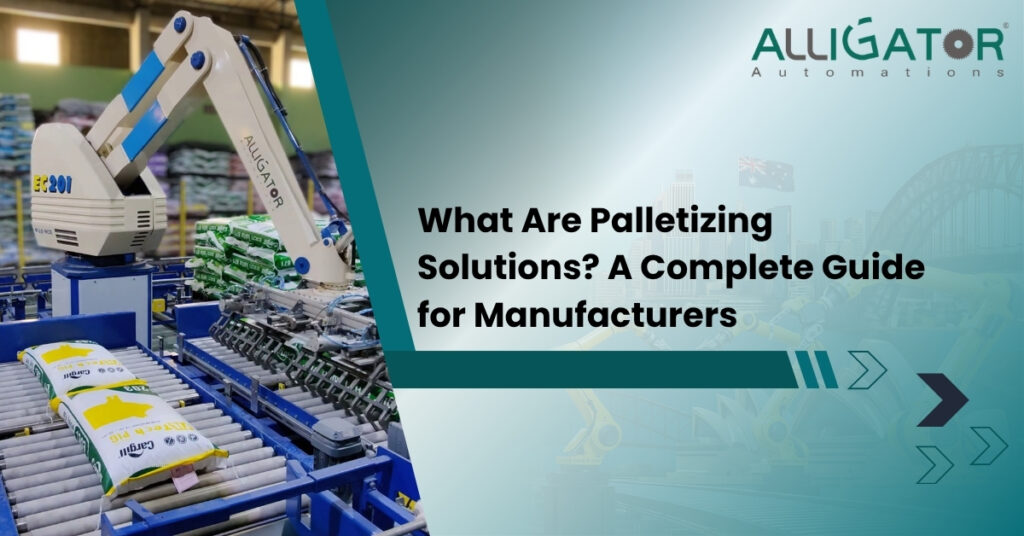
What Are Palletizing Solutions? A Complete Guide for Manufacturers
Summary: Palletizing solutions are automated systems that stack products onto pallets at the end of a production line, replacing costly and injury-prone manual labor. From collaborative robots ideal for small manufacturers to high-speed conventional layer palletizers built for 24/7 mass production, these solutions reduce labor costs by up to 40%, improve pallet consistency, and typically deliver ROI within 18–24 months. This guide covers every system type, how they work, industry applications, buying criteria, and real cost breakdowns everything manufacturers need to make a confident investment decision.
Table of Contents
ToggleIf your warehouse floor still relies on workers to manually stack heavy cases hour after hour, you’re leaving productivity and worker safety on the table.
Palletizing solutions are the systems, machines, and software that automate or semi-automate the process of arranging products onto pallets for storage or shipment. They sit at the heart of modern end-of-line operations, and for good reason: the global palletizing market is projected to reach $3.8 billion by 2028, driven by labor shortages, rising injury costs, and the relentless push for faster throughput.
This guide is written for plant managers, operations engineers, and logistics decision-makers who want a straight-talking, complete breakdown of palletizing solutions — what they are, how they work, which type fits your operation, and how to calculate real ROI before you sign a purchase order.
What Is a Palletizing Solution?
A palletizing solution is any system mechanical, robotic, or hybrid designed to place goods onto a pallet in a structured, stable, and repeatable pattern. The core objective is straightforward: load pallets efficiently, minimize product damage, and maximize trailer or warehouse cube utilization.
But modern palletizing solutions go far beyond simply stacking boxes. Today’s systems integrate seamlessly with upstream conveyor infrastructure, warehouse management software (WMS), manufacturing execution systems (MES), and ERP platforms to create a fully connected end-of-line workflow.
Whether you’re palletizing 25 kg bags of cement, fragile glass bottles, or mixed e-commerce cartons, there is an engineered palletizing solution matched to your specific product type, throughput requirement, and budget.
The term “palletizing solution” covers a broad spectrum from a $40,000 collaborative robot cell in a small food plant to a $2 million fully automated high-bay palletizing system in a national distribution center.
Why Palletizing Matters in Modern Manufacturing?
End-of-line operations where finished products transition from production into dispatch are among the most labor-intensive and injury-prone zones in any manufacturing facility. According to the Bureau of Labor Statistics, musculoskeletal disorders caused by repetitive manual handling account for over 30% of all workplace injuries in manufacturing.
Beyond safety, manual palletizing introduces three operational vulnerabilities that cost manufacturers money every single day:
Inconsistency: Human workers build pallets differently on the morning shift versus the night shift, leading to load collapses, retailer rejections, and damaged goods claims.
Throughput bottlenecks: A trained palletizer can stack roughly 300–500 cases per hour. A robotic system handles 1,000 – 2,500+ cases per hour without breaks, shift changes, or sick days.
Labor dependency: In an era of chronic skilled labor shortages, building your end-of-line operations around manual palletizing is a strategic vulnerability. Automation removes that dependency entirely.
What Are the Types of Palletizing Systems?
Understanding the five main categories of palletizing systems is essential before evaluating suppliers or building a business case.
Robotic Palletizers
Robotic palletizers use 6-axis articulated robot arms fitted with specialized end-of-arm tooling (EOAT) typically vacuum cup arrays, mechanical clamps, or fork attachments — to pick products from a conveyor and place them precisely onto a pallet.
Robotic palletizers are the most flexible option available. They can handle mixed SKUs, odd-shaped products, and multiple pallet patterns from a single machine, reprogrammed in minutes. Leading robot manufacturers in this space include FANUC, ABB, KUKA, Yaskawa, and Kawasaki.
Best for: Operations with multiple SKUs, frequent product changeovers, or 24/7 production schedules.
Conventional (Layer) Palletizers
Conventional palletizers form complete layers of product simultaneously and lower them onto the pallet as a single unit. They are mechanically simpler than robotic systems but extremely fast, capable of handling up to 100 layers per hour on high-speed beverage or canned goods lines.
The trade-off is flexibility. Conventional palletizers are purpose-built for a specific product format and pallet pattern. Changing products requires mechanical adjustments that can take hours.
Best for: Single-SKU, high-volume production lines such as bottling plants, canning operations, and bagged goods manufacturers.
Collaborative Robots (Cobots)
Cobot palletizers use force-sensing collaborative robots most commonly from Universal Robots, Doosan, or FANUC’s CRX series that are rated to operate safely alongside human workers without hard guarding.
Cobots carry lower payload ratings (typically up to 25 kg per pick) and slower cycle speeds than industrial robots, but their dramatically lower purchase price (starting from around $40,000–$80,000 installed) makes them the most accessible automated palletizing option for small and mid-size manufacturers.
Best for: SMEs, operations with floor space constraints, seasonal production peaks, or companies new to automation.
Semi-Automatic Palletizing Systems
Semi-automatic systems combine mechanical assistance roller conveyors, layer boards, and lift tables with human placement. Workers are physically supported and guided by the equipment but still make placement decisions.
These systems significantly reduce the ergonomic strain of manual palletizing while requiring minimal capital investment and no programming expertise.
Best for: Very low-volume operations, fragile specialty products, or businesses that need an immediate ergonomic improvement without committing to full automation.
Software-Driven and AI-Powered Palletizers
The newest category in the market, AI-powered palletizing software sits on top of existing robot hardware and uses machine learning algorithms to calculate optimal pallet patterns in real time even for irregular-shaped mixed loads. Companies like Dematic, Körber, and Symbotic have made significant advances in this space.
Best for: 3PL operators, e-commerce fulfillment centers, and any operation handling unpredictable mixed-case loads.
Manual vs. Automated: A Direct Comparison
Factor | Manual Palletizing | Semi-Automatic | Fully Automated / Robotic |
Throughput | 300–500 cases/hr per worker | 600–900 cases/hr | 1,000–2,500+ cases/hr |
Labor Cost | High (ongoing) | Medium | Low (minimal operators needed) |
Injury Risk | High (repetitive strain) | Low–Medium | Very Low |
Upfront CAPEX | Negligible | $30K – $120K | $100K – $500K+ |
Flexibility (mixed SKUs) | Excellent | Good | Excellent (robotic) / Limited (conventional) |
Consistency & Accuracy | Variable | Good | Near-perfect (±1mm) |
ROI Payback Period | N/A | 12–18 months | 18–36 months |
24/7 Capability | No (shift dependent) | Partial | Yes |
Best Suited For | Very low volume, fragile goods | SMEs, seasonal peaks | High-volume, continuous operations |
How Robotic Palletizing Systems Work — Step by Step
Understanding the mechanics of a robotic palletizing cell helps you evaluate vendor proposals, write accurate specifications, and have informed conversations with integrators.
Step 1 — Product Infeed and Orientation Detection
Products arrive via a take-away conveyor from upstream packaging or filling lines. Photoelectric sensors or 2D/3D vision systems detect each product’s position, dimensions, and orientation in real time. This data feeds directly into the robot controller.
Step 2 — Pallet Pattern Calculation
The control system — either the robot’s native software or a dedicated pallet pattern optimization application — calculates the most stable, space-efficient stacking arrangement for the current product and pallet size. Advanced systems recalculate this pattern dynamically when SKUs change mid-run.
Step 3 — Robotic Pick and Place
The robot arm moves to the calculated pick position, the EOAT engages the product (vacuum, clamp, or mechanical grip depending on product type), and the robot places it at the exact programmed coordinate on the pallet. Modern servo-driven robots achieve placement repeatability of ±0.5mm.
Step 4 — Interlayer Slip Sheet Placement
An automated slip sheet dispenser inserts cardboard or plastic interlayers between pallet layers at programmed intervals. This protects products from crushing damage and improves overall pallet stability during transport.
Step 5 — Pallet Completion, Wrapping, and Dispatch
When the pallet reaches its programmed height or case count, a signal is sent to the outfeed conveyor. The completed pallet transfers automatically to a rotary stretch wrapper, is film-wrapped for transit stability, receives a printed pallet label, and is staged for forklift pickup or conveyed directly to outbound loading docks.
Industry Applications by Sector
Industry | Typical Products | Recommended System Type | Primary Problem Solved |
Food & Beverage | Bottles, cans, cartons, trays | Robotic palletizer with vision system | High SKU variety, hygiene compliance |
Pharmaceuticals | Blister packs, cartons, vials | Cleanroom-rated robotic cells | Track-and-trace, fragile product handling |
Cement bags, bricks, tiles | Conventional layer palletizer | Heavy weight handling, high-speed throughput | |
E-commerce / 3PL | Mixed boxes, polybags | AI-driven cobot cells | Variable case sizes, mixed-SKU accuracy |
Drums, IBCs, pails | Heavy-duty robotic palletizer | ATEX zone compliance, hazardous materials | |
Dairy & Cold Chain | Yoghurt pots, milk cartons | Stainless steel washdown robots | Cold and wet environment operation |
Pet Food | Bags, pouches, cans | Multi-line robotic cell | High throughput, multiple line consolidation |
Paper & Publishing | Reams, boxes, rolls | Conventional or robotic hybrid | Precise stacking to prevent damage |
Key Factors to Evaluate Before Buying
Rushing into a palletizing purchase without proper specification work is one of the most common and costly mistakes manufacturers make. Before approaching any supplier, you need clear, documented answers to the following questions.
Technical Specifications You Must Define
Your peak throughput requirement in cases per hour is the single most important specification. Size the system for your peak demand not your average because a system that can’t keep up during your busiest period will create a production bottleneck that undermines the entire investment.
Product dimensions, weight range, and fragility characteristics determine which EOAT and robot payload class you need. Never assume a supplier’s standard gripper will work with your product, always request a product test before purchase.
The number of active SKUs and distinct pallet patterns you need to run determines whether a robotic or conventional system is the right choice. If you have more than three or four distinct pallet configurations, a conventional palletizer will likely cause more problems than it solves.
Available floor space and ceiling height are critical — robotic cells typically require a minimum of 4m x 4m of clear floor space, and conventional palletizers may need ceiling heights of 5m or more for their layer-forming heads.
Supplier Evaluation Criteria
Evaluation Criterion | Key Questions to Ask | Priority Level |
Industry Experience | How many installations in your specific sector? | Critical |
After-Sales Support | What is your response SLA? Do you have local service engineers? | Critical |
Safety Certification | Is the system CE marked? Does it meet ISO 10218 and ANSI/RIA R15.06? | Critical |
Software & Controls | Do you use open OPC-UA protocols? Is remote diagnostics available? | High |
Changeover Time | How long does a pallet pattern changeover take on your HMI? | High |
Spare Parts Availability | What is your parts stocking policy and lead time for critical components? | High |
Energy Consumption | What is the kWh consumption per 1,000 cases palletized? | Medium |
References | Can you provide two or three references in my industry? | Medium |
Common Mistakes Manufacturers Make When Buying Palletizing Solutions
Undersizing throughput capacity. Buying a system rated for your current average throughput rather than your peak demand is the most common specification error. Production lines grow. Systems should be sized for at least 120% of your current peak requirement.
Ignoring changeover time. A system that takes four hours to switch between pallet patterns will destroy the productivity gains you paid for if you run more than one or two product formats. Always test changeover time on the supplier’s demonstration equipment.
Skipping the factory acceptance test. A Factory Acceptance Test (FAT) at the supplier’s facility using your actual products is non-negotiable for any system above $100,000. Problems caught at FAT cost a fraction of what they cost to fix after installation.
Choosing the lowest capital cost over total cost of ownership. A cheaper system with higher annual maintenance costs, slower support response times, and proprietary spare parts will almost always cost more over a five-year horizon than a better-specified system from a reputable supplier.
Underestimating integration complexity. Connecting a new palletizing system to an existing conveyor network, WMS, and production control system is almost always more complex — and more expensive — than the initial quote suggests. Budget a contingency of 15–20% of the system cost for integration work.
Why Choose Alligator Automations Australia for Your Palletizing Needs?
When it comes to selecting a palletizing solution partner in Australia, experience, local knowledge, and end-to-end capability matter just as much as the equipment itself. Alligator Automations Australia ticks every one of those boxes — and then some.
Based in Schofields, New South Wales, Alligator Automations is a leading innovator in industrial automation, specializing in end-of-line packaging solutions that enhance efficiency, accuracy, and cost-effectiveness. With a strong footprint across Australia and a growing international presence, they have become one of the most trusted names in palletizing and packaging automation for Australian manufacturers.
A Complete End-of-Line Automation Partner
Most automation suppliers sell you a machine. Alligator Automations delivers a complete solution. Their product range includes Automatic Bagging Solutions, Case Packaging, Palletizing, Intralogistic Conveyor Solutions and Automatic Truck Loading Solutions all designed to boost productivity while ensuring reliability and minimal human intervention.
This means whether you need a standalone robotic palletizer or a fully integrated end-of-line system connecting bagging, palletizing, stretch wrapping, and automated truck loading, Alligator Automations can design, supply, and commission the entire line from a single source eliminating the integration headaches that come with managing multiple vendors.
Full Range of Palletizing Systems Under One Roof
Alligator Automations offers every major palletizing system type, giving Australian manufacturers genuine choice rather than a one-size-fits-all approach. Their full palletizing lineup includes:
- Robotic Palletizers — 6-axis robots with adaptive grippers for maximum flexibility and mixed-SKU handling
- Gantry Palletizers — a cost-effective alternative to multi-axis robots, ideal for heavy products with multiple inputs and outputs
- High Level Palletizers — high-speed layer-forming systems built for continuous, high-volume single-SKU lines
- Low Level Palletizers — ground-level systems offering easy access, low maintenance, and precise layer formation
- Hybrid Palletizers — combining robotic flexibility with high-level compaction, ideal for bag stacking operations
This breadth of range is particularly valuable when your throughput requirements change over time. Rather than switching suppliers as your operation scales, Alligator Automations can grow with you upgrading or expanding your system within the same engineering ecosystem.
Industries Served Across Australia
Alligator Automations serves a wide range of industries through their Industries We Serve portfolio, including:
- Food & Beverages — dairy, flour, sugar, pet food, spices, and more
- Agriculture — cereal grains, rice, pulses, soybean, and agro commodities
- Chemicals & Fertilizers — including carbon black, plastic pellets, and detergent powders
- Building Materials — cement, sand, and construction materials
- Animal Feed — high-throughput bagging and palletizing for feed producers
- Pet Food — flexible multi-line systems for pouches, cans, and bags
This cross-industry depth means their engineering teams understand the specific hygiene, safety, throughput, and compliance requirements of your sector — not just generic automation principles.
Pallet Packaging — The Complete End-of-Line Picture
Palletizing is only one part of securing your load for dispatch. Alligator Automations also supplies the full range of Pallet Packaging Solutions that sit immediately downstream of your palletizer, including Stretch Wrapping, Strapping, Stretch Hood, and Thermo Shrinking — all engineered to work seamlessly with their palletizing cells as a single integrated end-of-line system.
Proven Track Record with Global and Australian Brands
Alligator Automations is trusted by industry leaders including Coca-Cola, PepsiCo, Cargill, Shell, Petronas, Hershey’s, and P & G, a client roster that speaks directly to the reliability and performance of their systems at scale. For Australian manufacturers, this global validation translates into confidence that the technology and engineering standards behind every installation are genuinely world-class.
Cargill’s operations team noted that Alligator Automations adhered strictly to project standards, timelines, and quality requirements, ensuring flawless execution — and that even post-commissioning, their responsiveness and proactive support ensured stable machine operation.
You can learn more about the team and their facility on the About Alligator Automations and Our Facility pages.
After-Sales Support You Can Rely On
Buying the right machine is only half the equation. Alligator Automations backs every installation with a structured Services program covering Service Contracts and AMC, Spare Parts supply, System Upgrades, and Operator Training and Learning — ensuring your system continues to perform at specification long after commissioning day.
Why Australian Manufacturers Choose Alligator Automations?
What Matters to Manufacturers | What Alligator Automations Delivers |
Local presence and support | Office in Schofields, NSW with Australian-based team |
Full end-of-line capability | Palletizing, bagging, conveying, truck loading — all in-house |
Proven global technology | Installations across 14+ countries including Fortune 500 clients |
Industry-specific expertise | Solutions for FMCG, pharma, agro, chemicals, and more |
Competitive pricing | Best cost-to-engineering ratio in the Australian market |
After-sales reliability | Service contracts, spare parts, upgrades, and operator training |
Australian Standards compliance | Engineering designed to local regulatory requirements |
Get in Touch with Alligator Automations Australia
If you’re ready to explore palletizing automation for your facility, the Alligator Automations team offers consultations to help you identify the right system for your throughput, product type, and budget. Visit their Contact Us page or reach them directly below.
Phone: +61 428 724 441 Email: [email protected]
Frequently Asked Questions
What is the difference between a palletizer and a depalletizer?
A palletizer stacks products onto a pallet at the end of a production line, while a depalletizer removes products from incoming pallets at the start of a line. Many robotic systems can perform both functions with a simple tool or program change, which makes them highly valuable for operations that both receive bulk materials and dispatch finished goods.
Can one robot handle multiple production lines?
Yes. In a multi-line configuration, a single robot mounted on a linear track — called a “7th axis” — can service two to four infeed conveyors simultaneously. This is a popular approach in beverage facilities with multiple filling lines converging in one palletizing hall, and it substantially strengthens the capital cost justification.
How long does installation and commissioning take?
A standard robotic palletizing cell typically takes 8–14 weeks from order placement to live production. This includes mechanical installation (1–2 weeks), electrical integration (1–2 weeks), PLC and HMI programming and pallet pattern teaching (1–2 weeks), and factory acceptance testing plus site acceptance testing.
What payload capacity do I need?
Specify payload based on your heaviest single pick — which may be one case, one bag, or an entire row of products depending on your EOAT design. Standard palletizing robots range from 50 kg for light carton and pouch applications to 500 kg or more for drums, sacks, and construction materials. Always verify the payload rating at maximum reach, not at the robot’s centreline, as payload drops significantly at extended arm positions.
Is robotic palletizing suitable for small manufacturers?
Absolutely. Collaborative robot palletizing systems start from around $40,000–$80,000 installed. Robot-as-a-Service (RaaS) leasing models are also increasingly available from integrators, which convert the investment from a capital cost into a monthly operating expense removing the CAPEX barrier entirely and making automation accessible to businesses of almost any size.
What industries benefit most from palletizing automation?
Food and beverage, pharmaceuticals, building materials, consumer goods, chemicals, and e-commerce fulfillment all see strong returns from palletizing automation. Any industry running more than one shift with repetitive end-of-line stacking requirements will typically achieve a positive ROI within two years.
Recent Posts
Categories
Browse Our Automation Solutions
Explore our complete product catalogue and find the perfect solution for your industry.