
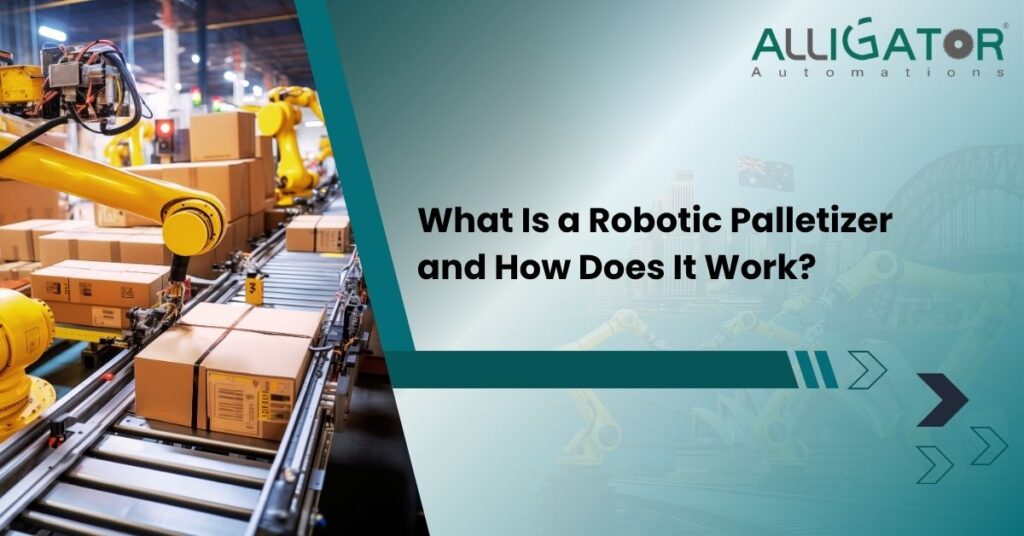
What Is a Robotic Palletizer and How Does It Work?
Summary : This blog explains what a robotic palletizer is, how it works, and why it has become an essential part of modern end-of-line packaging systems & solutions. In today’s fast-paced manufacturing and logistics environment, businesses are constantly looking for ways to improve efficiency, reduce labor dependency, and ensure consistent product handling. Robotic palletizers are one of the most effective automation technologies helping industries achieve these goals.
Table of Contents
ToggleA robotic palletizer uses advanced robotic arms, sensors, and intelligent programming to automatically stack products, cartons, or bags onto pallets in a precise and structured manner. Unlike manual palletizing, which is time-consuming and physically demanding, robotic systems offer speed, accuracy, and flexibility across multiple product types and packaging formats.
From food and beverage to pharmaceuticals, FMCG, and industrial goods, robotic palletizers are transforming warehouse and production line operations. Let’s understand how they work, their components, benefits, and why they are becoming a core part of end-of-line automation.
What Is a Robotic Palletizer?
A robotic palletizer is an automated system equipped with an industrial robotic arm designed to pick up products from a conveyor belt and place them in a specific pattern on a pallet.
Unlike traditional manual palletizing, which requires workers to lift and stack heavy loads repeatedly, robotic palletizers perform these tasks using programmed instructions.
The system typically includes:
- A robotic arm (often 4-axis or 6-axis)
- Grippers or end-of-arm tooling (EOAT)
- Conveyor systems
- Sensors and controllers
- Pallet staging area
The robot follows pre-programmed patterns to ensure each pallet is stable, balanced, and ready for transportation or storage.
What Is The History Of Palletizing?
Palletizing began in the early 20th century when industries needed faster ways to handle growing production volumes. Initially, palletizing was done manually, which was labor-intensive, slow, and prone to injury risks.
In the 1950s and 1960s, mechanical palletizers were introduced to automate repetitive stacking tasks. These machines used mechanical arms and fixed patterns but lacked flexibility.
With the rise of industrial robotics in the late 20th century, robotic palletizers emerged as a more advanced solution. Unlike conventional systems, robotic palletizers offered programmable flexibility, allowing manufacturers to handle multiple product types on a single system. Today, they are a key part of smart factories and Industry 4.0 automation systems.
How Does a Robotic Palletizer Work?
A robotic palletizer operates through a coordinated sequence of automated steps. Each step is carefully programmed to ensure efficiency and accuracy.
Step 1: Product Arrival on Conveyor
Products such as cartons or bags move along a conveyor belt toward the palletizing station. These products may already be grouped or individually spaced depending on production requirements.
Step 2: Product Identification
Sensors or vision systems identify the product’s position, size, and orientation. This ensures the robotic arm picks up the item correctly.
Step 3: Robotic Pick-Up
The robotic arm uses an end-of-arm tool (like a vacuum gripper or clamp) to securely pick up the product from the conveyor.
Step 4: Movement and Positioning
The robot moves the product along a programmed path. It calculates the most efficient route to the pallet while avoiding collisions or delays.
Step 5: Placement on Pallet
The product is carefully placed on the pallet according to a pre-set stacking pattern. These patterns are designed to maximize space and ensure stability.
Step 6: Layer Completion
Once one layer is completed, the system begins stacking the next layer with alternating patterns if required for stability.
Step 7: Pallet Changeover
When a pallet is fully stacked, it is automatically moved out and replaced with an empty pallet for continuous operation.
This fully automated cycle allows businesses to run packaging lines with minimal human intervention.
What Are The Types And Use Cases Of Robotic Palletizers?
Robotic palletizers come in different configurations depending on industrial needs and production volume.
Articulated Arm Palletizers
These are the most common type, featuring multi-jointed robotic arms that provide high flexibility and speed. They are ideal for complex stacking patterns and mixed-product palletizing.
Gantry Palletizers
Gantry systems operate on overhead tracks and are suitable for heavy loads and large-scale operations. They are widely used in manufacturing and logistics industries.
Collaborative Robotic Palletizers
These systems are designed to work alongside human operators safely. They are commonly used in small to medium production facilities.
Use Cases
Robotic palletizers are used across industries such as:
- Food and beverage packaging
- Pharmaceuticals and healthcare
- FMCG and retail distribution
- Chemicals and fertilizers
- Warehousing and logistics
Their adaptability makes them suitable for both high-speed production lines and flexible batch operations.
Robotic Palletizing Vs Conventional: Which Is Best?
When comparing robotic palletizing with conventional systems, the differences become clear in terms of flexibility, speed, and scalability. Conventional palletizers are typically designed for high-volume, single-product operations. They are efficient but lack adaptability. If product sizes or packaging formats change, significant mechanical adjustments are required.
Robotic palletizers, on the other hand, are software-driven and highly flexible. They can easily switch between different product types and stacking patterns without major downtime. In terms of long-term value, robotic systems generally offer better ROI due to reduced labor costs and increased adaptability. However, conventional systems may still be suitable for highly standardized, large-scale production lines.
Factor | Robotic Palletizing | Conventional Palletizing |
Flexibility | Highly flexible and can handle multiple product types easily | Limited flexibility, mostly designed for single-product formats |
Speed & Efficiency | Consistent speed with minimal downtime | Very fast in fixed, high-volume production setups |
Changeover Ability | Quick changeovers with software reprogramming | Requires mechanical adjustments and more downtime |
Cost & ROI | Higher initial cost but better long-term ROI due to automation | Lower initial cost but higher long-term labor and maintenance costs |
Scalability | Easily scalable and adaptable for future production changes | Less scalable, suitable for fixed and standard production lines |
Ultimately, the best choice depends on production needs, budget, and future scalability requirements.
What Are The Benefits And Applications Of Robotic Palletizers?
Robotic palletizers provide a wide range of operational benefits across industries.
Increased Productivity
They significantly speed up end-of-line operations, allowing businesses to handle larger production volumes efficiently.
Improved Accuracy
Every product is placed with precision, ensuring stable and uniform pallets that reduce damage during shipping.
Space Optimization
Robotic systems often require less floor space compared to traditional palletizing machines, making them ideal for compact facilities.
Enhanced Scalability
As production grows, robotic palletizers can be reprogrammed or upgraded rather than replaced entirely.
Industry Applications
These systems are widely used in:
- Manufacturing plants for packaging finished goods
- Distribution centers for sorting and shipping products
- Food processing units for hygienic and fast handling
- E-commerce fulfillment centers for rapid order processing
The versatility of robotic palletizers makes them a core component of modern automation strategies.
What Things Should You Consider Before Choosing A Robotic Palletizer?
Before investing in a robotic palletizer, several important factors should be evaluated.
Product Type And Load Characteristics
You must consider the size, weight, and fragility of the products being handled. This determines the type of gripper or robotic arm required.It also ensures the system can safely handle different packaging materials without damage.
Production Speed Requirements
Understanding your line speed is essential to ensure the robotic system can meet output demands without bottlenecks. It helps in selecting a palletizer that maintains consistent performance during peak production hours.
Floor Space Availability
Although robotic systems are compact, proper layout planning is necessary for optimal efficiency. It also helps in ensuring safe movement and smooth integration within the production line.
Integration With Existing Systems
The palletizer should integrate smoothly with conveyors, packaging machines, and warehouse systems. Proper integration reduces downtime and improves overall automation efficiency.
Flexibility And Future Expansion
Choose a system that can adapt to future production changes and scaling needs. This ensures long-term value and reduces the need for frequent system replacements.
Boost Productivity And Reduce Costs With Our Robotic Palletizing Systems
If your business is looking to improve productivity and streamline packaging operations, Alligator Automations Australia provides advanced end-of-line packaging systems designed for modern industrial needs. Our robotic palletizers are built to deliver precision, speed, and reliability across a wide range of industries.
We specialize in delivering customized automation systems that fit your production requirements and help you achieve operational excellence. From system design to integration, our solutions ensure seamless performance and long-term efficiency. Whether you are upgrading your facility or setting up a new production line, we can help you build a smarter and more efficient packaging process.
To learn more about how automation can transform your operations, contact us today. Our team is ready to help you choose the right robotic palletizing solution that enhances productivity and reduces costs.
Frequently Asked Questions
What Is A Robotic Palletizer Used For?
A robotic palletizer is used to automatically stack products like boxes, bags, and cartons onto pallets for storage or shipping in an efficient and organized way.
How Does A Robotic Palletizer Improve Efficiency?
It increases efficiency by automating repetitive stacking tasks, reducing manual labor, and operating continuously with consistent accuracy.
Are Robotic Palletizers Suitable For Small Businesses?
Yes, modern robotic palletizers are scalable and can be customized for small to medium-sized operations depending on production needs.
What Industries Use Robotic Palletizers The Most?
They are widely used in food and beverage, pharmaceuticals, manufacturing, logistics, and e-commerce industries.
Do Robotic Palletizers Require A Lot Of Maintenance?
No, they generally require moderate maintenance, and with proper servicing, they offer long-term reliable performance with minimal downtime.
Recent Posts
Categories
Browse Our Automation Solutions
Explore our complete product catalogue and find the perfect solution for your industry.